Turning strategy into software: Europe's roadmap for sovereign AI
If Part 1 named the dependency and Part 2 set the direction, this final chapter is about the build: who controls the interface, who learns from use, and who captures the money flow.
In Part 2, we showed how Europe can compete differently by owning the aggregation layer itself, whether as one trusted companion or an open ecosystem that shares the same alignment standards.
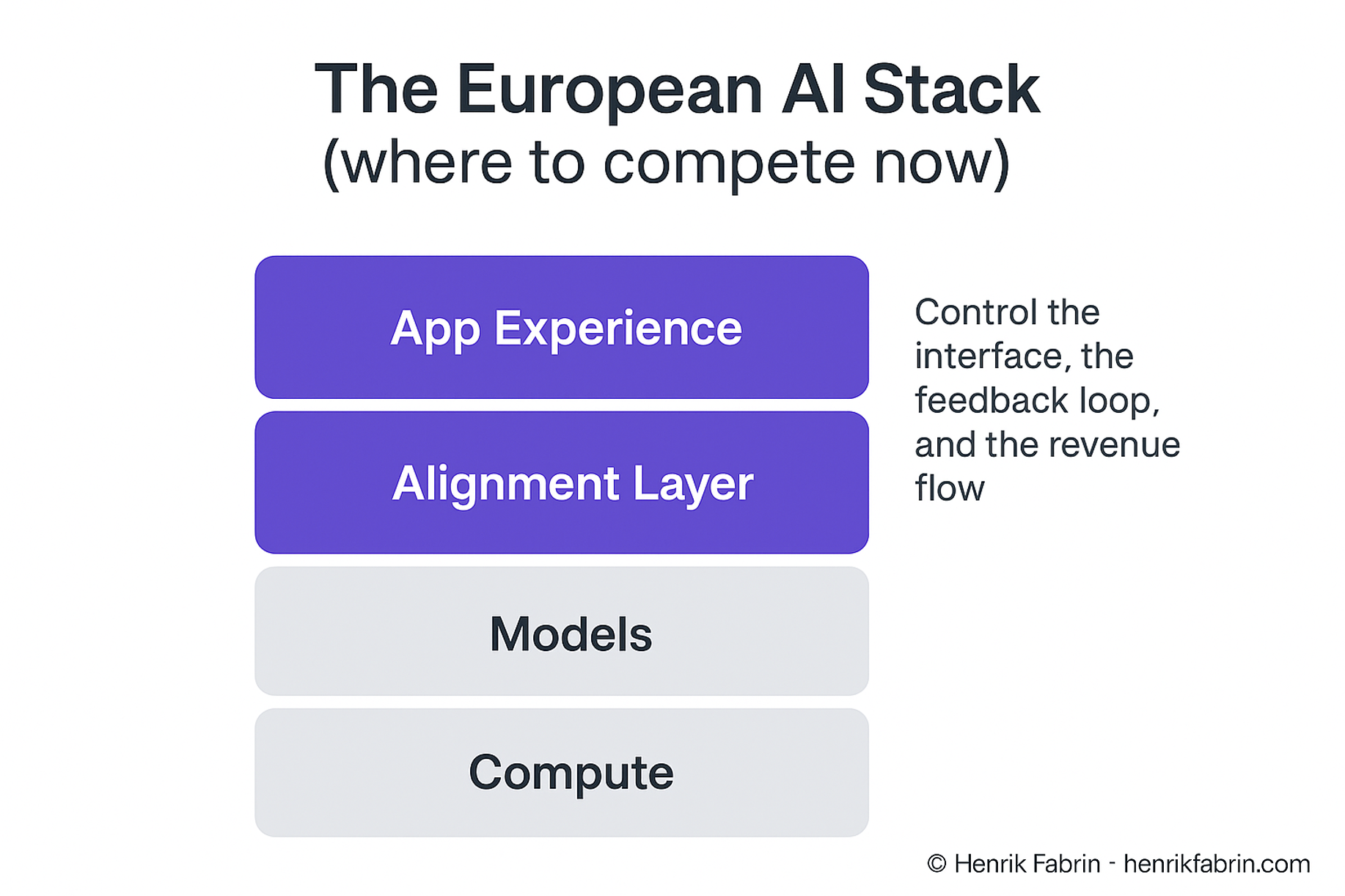
The goal isn't to "win the model race." It's to own the alignment layer and the app experience that sit between raw capability and real people, and to distribute that through Europe's existing networks of trust and convenience.
What is the alignment layer?
The alignment layer is a design and governance framework – not a single piece of software.
It's the set of principles and patterns that determine how AI systems behave when they meet people: what they remember, how they explain, how they show sources, and how they respect consent. It guides how we build experiences, choose integrations, and route models at runtime – always through the lens of European values: transparency, reversibility, user control, and trust.
OpenAI and others are racing to become the personal AI you use everywhere: in your phone, mail, car, calendar, and wearables. Europe doesn't need to block that race. We need to offer an alternative that people choose because it's transparent, helpful, convenient, and unmistakably European by design.
Europe's AI playbook: start where users are, own the alignment layer, design the experience, and expand downward as the ecosystem matures.
Why the alignment + app layers are the control point
In AI, value compounds where three loops meet:
- the user loop: who holds the billing relationship and the daily habit
- the learning loop: who improves fastest from local context and real usage
- the distribution loop: who reaches millions by default, not by chance
Models are becoming easier to swap – interoperable at the API level – but they still perform differently by task, language, and context. That's exactly why the alignment layer matters: it decides which model to use when, and how to make the experience consistent regardless of what's running underneath. What isn't interchangeable is how the model is aligned (guardrails, memory, retrieval, consent, tone) and how the experience feels (language, sources, integrations, defaults).
That is where convenience, delight, and loyalty form, and where revenue concentrates. If Europe controls these two layers, the user, the data exhaust that drives improvement, and the high-margin spend stay here.
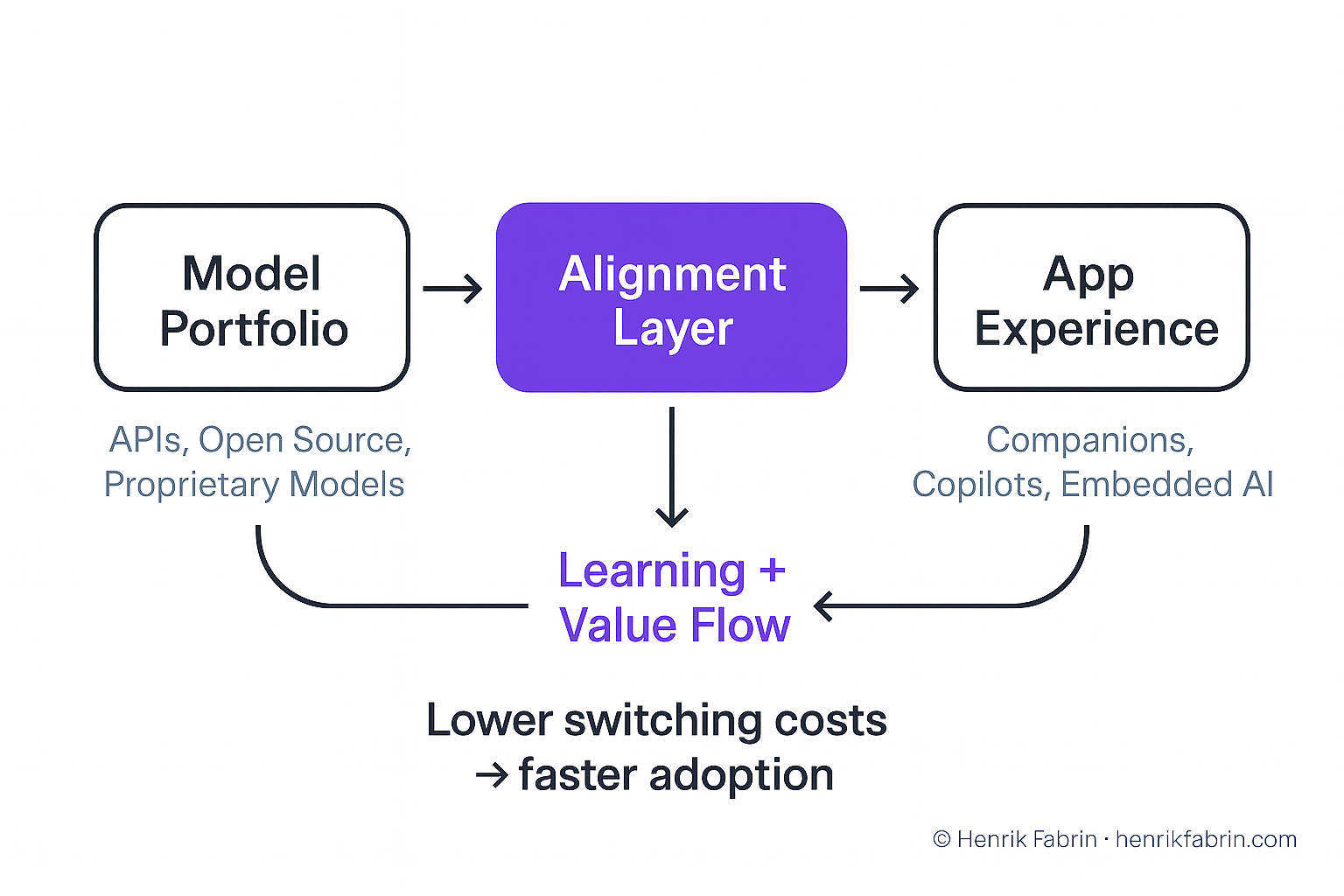
Model strategy: portfolio, not ideology
Here, we apply Europe's core strengths: trust, coordination, diversity, liveability, and governance directly to product and ecosystem design.
Europe should compete where we can win right now: at the layers closest to users, where product experience and trust decide adoption. As the ecosystem matures, we'll expand downward in the stack, building vertically wherever it adds differentiation.
We'll benefit from APIs, open-source models, and, when the time is right, our own. The goal isn't ideological purity; it's strategic sequencing: starting where value and control already converge.
We win by orchestrating a portfolio behind one European alignment layer, not by insisting on a single "European model," and not by outsourcing everything to U.S. providers.
- European models where transparency, localisation, or on-EU-soil deployment matters
- best-in-class global models where a specific capability, multimodality, or latency is clearly superior
- small/task models and on-device where privacy, cost, or energy efficiency demand it
Users never pick a model. They experience one trustworthy European layer that routes to the best engine for the job, applies the same governance and memory rules, and presents one consistent UX. Selection should be based on performance for the specific task, cost, and control – not branding.
Partnership is Europe's engine: consumer and business networks
Europe's strength lies in its ability to connect – through the systems that reach consumers and the institutions that enable businesses. Consumer-facing networks build familiarity and trust: they meet people where they already are, in the digital services they use every day. Business-facing networks turn that trust into competitiveness: they help companies adopt AI safely, productively, and at scale.
Consumer adoption: reach through everyday services
Telecom providers, device makers, and media organisations connect AI to consumers through the channels they already use – phones, subscriptions, news apps, cars, and homes. Their incentive is reach and relevance: AI keeps their services central to daily life, strengthens loyalty, and opens new revenue streams for personalised experiences. Each trusted touchpoint builds digital literacy and normalises safe, transparent use – trust as a network effect.
Business adoption: capability through institutions
On the business side, adoption flows through Europe's dense network of trade associations, chambers, and public–private programmes that help firms modernise and grow. Organisations like Danish Industry (DI) or national business-promotion frameworks such as the Danish Board of Business Development (DBBD) illustrate how local ecosystems translate regulation into practical tools, connect firms with training and funding, and scale proven use cases across regions.
Across the market, SMEs and larger enterprises act as early adopters of trustworthy European AI products, integrating them into daily workflows for productivity, service, and decision-making. Each time a company chooses a European solution over a non-European one, it strengthens the ecosystem, creates demand for local innovation, and demonstrates that alignment, quality, and performance can coexist.
Together, these institutions and companies turn Europe's policy goals into operational capability, ensuring that even small and mid-sized firms benefit from AI without outsourcing control.
In short: distribution runs through consumer networks; adoption runs through business networks. When both move in sync – consumer trust feeding business confidence – Europe's flywheel accelerates: trust → adoption → productivity → competitiveness → more trust. That's the partnership model that makes Europe's distributed structure a strategic advantage, not a handicap.
It's the Spotify-Apple lesson in distribution: Apple owned the hardware; Spotify owned the relationship. Europe can do the same in AI; we may not control devices, but we can control the experience.
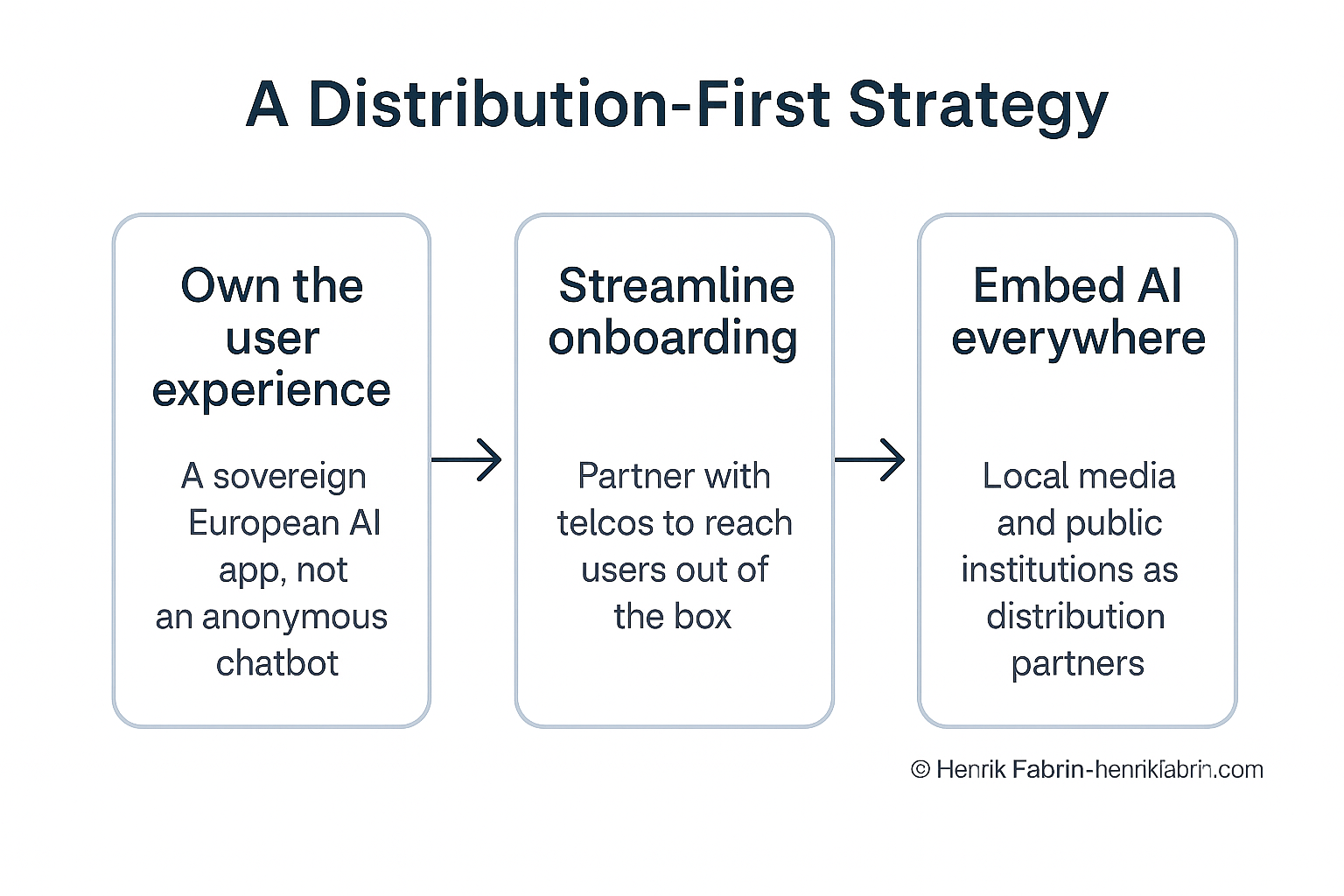
Think of this blueprint as one European AI Companion: a single trusted interface that adapts across contexts, much like Spotify unified music access across devices.
Three strategic use cases: not products
Europe's AI blueprint must serve both sides of the market: people and production. The Everyday Companion builds citizen trust; the SME and Education Copilots turn that trust into competitive capacity. Together they form the consumer–enterprise flywheel that anchors European AI sovereignty.
These aren't SKUs. They are demonstrations of the European blueprint across daily life, business, and public value. They can live as modules inside one European AI platform: a single companion that grows into an ecosystem, the way super-apps integrate services without fracturing the user relationship.
1) The everyday companion: convenience, delight, trust
A multilingual assistant that feels local in tone and examples; shows provenance by default; makes memory explicit and reversible; and explains how it answered, including what it's unsure about.
Integrations include mail, calendar, documents, and local systems such as national IDs, health portals, and digital post, all opt-in, legible, and easy to revoke.
It wins because it is faster and more useful, and it happens to be safer.
2) The SME copilot and agents: utility with data control
Handles quoting, proposals, customer replies, claims, and invoice questions; autonomous agents execute bounded workflows like scheduling and follow-ups under human oversight.
European companies adopt these tools to serve customers more effectively. Sensitive data stays on EU servers or devices; the payoff is productivity, innovation, competitiveness, and faster cycles, with spending and learning loops kept in Europe.
3) The education copilot: learning as habit
A reading and writing coach that teaches craft: "explain," "compare options," "show me what good looks like."
Teacher and student modes, visible sources, and age-appropriate guardrails. Distributed through national platforms, it builds early familiarity with AI, and social licence to use it responsibly.
Design that makes sovereignty felt
People don't adopt AI out of duty; they adopt it because it saves time, feels rewarding, and sparks curiosity. Sovereignty isn't a sermon; it's the outcome of good design: useful, simple, and fun.
- provenance by default: sources, reasoning, and tool calls a tap away; uncertainty shown rather than hidden
- memory with consent: clear controls; one-tap "forget"; one-tap export
- local fluency: language, tone, humour, and examples that fit the user's world
- learning-first UX: "explain," "stress-test," "compare," and "what good looks like" as core actions
- gaming-inspired loops: progression, mastery, and playful exploration that make improvement satisfying; habits form when learning feels like a win, not a chore
- privacy options that matter: EU hosting or on-device where it counts; telemetry tracks what the system did, not what the user wrote
When sovereignty is convenient, fun, and clearly useful, people choose it voluntarily.
Data mobility: make the DMA real
The Digital Markets Act gives Europeans the right to take their data with them. Our products should make that right work in practice:
- one-click export and import: move your data, memory, and preferences into and out of any assistant in minutes
- portable memory: human-readable summaries of what's moving and why
- consent that travels: your choices follow you, not the vendor
Portability shouldn't only let people leave; it should let them arrive. Lowering switching costs is both user-friendly and market-smart: the easier it is to switch in, the faster Europe gains share.
How we build: sequence, not schedules
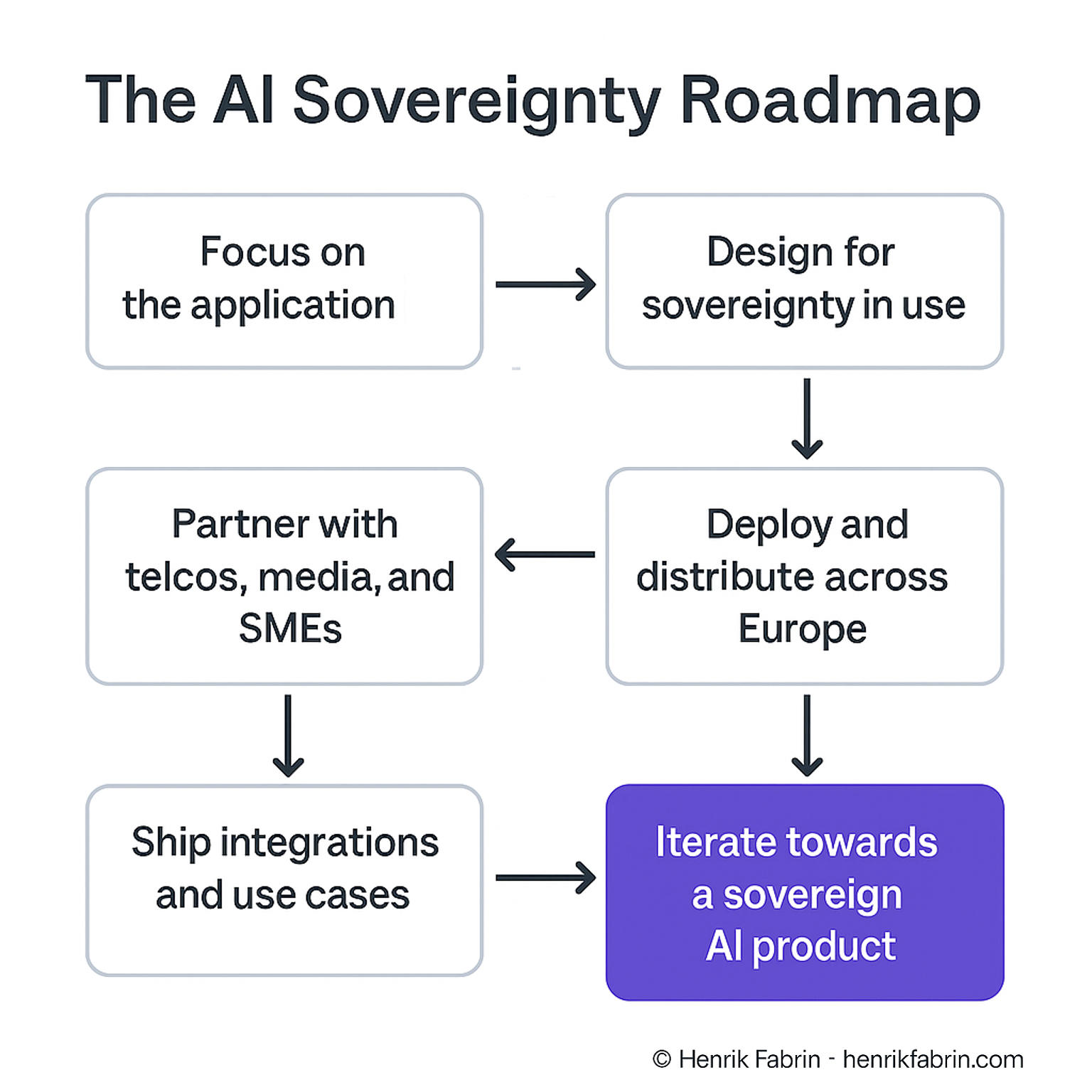
build: stand up the alignment layer: guardrails, retrieval with citations, explicit memory/consent, portfolio routing, public evaluation. Prove governance and UX in one market first.
distribute: activate partners: telco bundles, SME channels, education platforms, and media archives for sourced answers. The same companion can be embedded inside media sites and apps to meet users where they already are.
scale: expand languages, sectors, and partners; keep UX and alignment consistent so every new use improves the whole system. In parallel, integrations expand to more local systems (IDs, health, payments) to deepen convenience.
sustain: rotate models as costs and capabilities evolve; maintain public dashboards; grow local data trusts; extend on-device options when they genuinely help.
Distribution doesn't stop at partnerships. Once daily utility is clear, growth comes from viral word of mouth and coordinated marketing that highlight convenience and trust in equal measure. The better it feels, the faster adoption spreads.
What we measure: and why it's public
Consumer trust metrics: daily active use, provenance views, consent edits.
Enterprise impact metrics: cycle-time reduction, SME cost savings, adoption rate in regulated sectors.
- habit: daily and weekly use; time-to-first-value under 30 seconds
- trust in use: share of sessions with source views, "explain" taps, and consent edits
- impact: SME cycle-time reduction; teacher adoption and student rubric gains
- efficiency: cost and energy per task published alongside accuracy and bias
If we ask Europe to believe in European AI, we let Europe inspect it.
The complete series
This is Part 3 of a three-part series on Europe's AI trajectory:
- •Part 1: Europe's AI Dependency Problem – diagnosed how adoption is soaring while value flows abroad
- •Part 2: How Europe Can Act – set the direction using our structural advantages
- •Part 3: From Direction to Design (you're reading it now) – turns strategy into software
Let's build it together
This blueprint isn't a thought experiment; it's a starting point.
If the last decade was about platforms that captured our attention, the next can be about intelligence that earns our trust. Let's build the European AI that people actually want to use.
You can reach me directly at henrik@henrikfabrin.com.
Let's build European AI that people actually want to use.