From dependency to direction
I've spent the better part of my career building and scaling companies in Europe: incorporating in multiple countries, hiring across borders, and selling to customers around the world. In the last few years, through my role at Danish Industry, I've also sat with hundreds of leaders trying to make sense of AI: where to start, what to trust, and how to move from pilots to impact. That combination (operator inside the system + advisor across it) shapes how I see Europe's path forward.
That's why this piece isn't a policy paper. It's a strategy chapter, written from lived experience. Part 1 diagnosed the dependency problem. Part 3 turns strategy into software. Here, I'll focus on the direction: what Europe can choose to do, and why our conditions make that choice realistic.
From imbalance to opportunity
Part 1 showed how Europe's AI demand flows through foreign layers: assistants, enterprise copilots, cloud, model APIs. Data and spend follow those layers; margins do too.
Europe is one of the world's largest and most diverse economic networks, linked by shared standards, trusted institutions, and interoperable markets. The ability to coordinate that scale is our real edge.
Europe's AI opportunity has two fronts: consumers and companies. Consumer adoption builds literacy and trust; enterprise adoption turns that trust into productivity. Both loops must reinforce each other if sovereignty is to scale.
And yet, this imbalance is recoverable because Europe still controls three deep levers:
- •Scale, with diversity. A 600-million person market (excluding Russia) is not fragmentation; it's critical mass with built-in robustness across languages and cultures.
- •High social trust. People accept shared rules and institutional stewardship, essential for responsible data use and fast adoption.
- •Quality of life. Founders who went west to raise capital are coming home to raise families. In the long run, where people want to live becomes where they want to build.
These aren't soft values. They're competitive assets.
The case for agency (from an operator's vantage point)
Trust is productivity
Europe's advantage isn't moral; it's operational. When businesses and citizens trust how data and AI are handled, adoption scales faster and coordination costs drop. In high-trust markets, trust isn't a value statement; it's a growth engine.
Equality is an innovation safety net
Europe's social model (healthcare, education, worker protections) is often framed as cost. In practice, it lets founders and teams take real risks without catastrophic downside. I've seen it first-hand: you can swing bigger when failure doesn't mean falling through the floor.
Transparency isn't about PR; it's infrastructure
Transparency isn't about PR; it's infrastructure. When models, data sources, and decisions are open by design, ecosystems coordinate faster — suppliers, regulators, and innovators all operate from the same map. It turns governance from a bottleneck into a feedback loop.
Scale + diversity = rigorous generalisation
If an AI product works across Danish municipalities, Spanish SMEs, Polish factories, and Catalan classrooms, it's stress-tested for the world. Europe is the best validation market for AI that must cope with nuance.
Liveability keeps talent
Many of us left to raise money, then returned to live better. Safe cities, culture, public infrastructure, and family-friendly norms matter more as careers progress. Europe doesn't need to out-pay Silicon Valley if it out-lives it; quality of life is a long-term magnet for founders, researchers, and operators.
From regulation to competitiveness (when rules help and when to get out of the way)
I'm not a policymaker. I'm a builder who has dealt with the consequences of policy. From that vantage point:
Regulation is a lever when it does three things
- Creates clarity. Simple, stable rules shorten the path from prototype to production. (Ambiguity is slower than almost any safeguard.)
- Builds trust. Safety, provenance, and consent must be visible in the interface, not just in a PDF. (People adopt what they can see and control.)
- Opens markets. Interoperability and data portability reduce lock-in so better products compete on merit.
Regulation is a drag when:
- •every experiment needs an exemption;
- •27 interpretations create 27 frictions;
- •compliance costs more than the feature being shipped.
The middle path: regulate the interface, free the engine
Set clear expectations for how AI meets people (explainability, memory, consent, and rights) while liberating iteration: shared evaluation datasets, sandboxes with light oversight, and mutual recognition so a launch in one member state scales across the EU without re-papering.
A useful triad for this moment: productivity, transparency, innovation
If a rule raises all three, it's the right rule. If it depresses one without lifting the others, rethink it. That's the filter we should apply now.
Europe needs its "Delaware moment" (formation without friction)
A practical blocker I've felt repeatedly: formation and scaling are too fragmented.Different company laws, stock-option regimes, and taxation rules create drag you can't justify at early stage.
We need an EU-INC style framework: a simple, optional corporate structure with harmonised stock options, predictable taxation, and automatic cross-border recognition. Think of what Delaware did in 1913 for American companies: one clean on-ramp, national by design.
This isn't deregulation for its own sake. It's competitiveness-oriented simplification: remove structural drag while keeping standards high. EU-INC: 27 markets, one rulebook: a startup passport for AI builders.
The ecosystem mindset: Europe's networks as a competitive engine
Europe's economy already runs on networks: supply chains, cooperatives, and public-private partnerships. What looks like fragmentation from the outside is actually distributed strength: thousands of institutions linked by shared standards, trust, and accountability.
That structure is exactly what the next generation of AI needs. Where the U.S. builds centralised platforms and China builds state ecosystems, Europe can build federated intelligence: connected, interoperable, locally governed.
Instead of one monolith, we need a coordinated network of builders, institutions, and regulators that turn Europe's institutional and cultural capital into reach and resilience. That's the European pattern: alliances that turn values into velocity.
The ecosystem participants each have clear incentives to join. Part 3 explores these partnerships in detail and shows how they create the alignment layer in practice.
These networks connect the consumer interface (where Europeans meet AI daily) with the enterprise stack where data and value accumulate. Designing for both fronts ensures that trust and competitiveness rise together.
Trust drives data-sharing, data drives better models, and better models reinforce trust: Europe's natural flywheel.
🇪🇺 Europe in practice: five companies, one playbook
These aren't hypotheticals. Across industries, European companies are already proving how to turn regional strengths (trust, culture, and deep domain knowledge) into global advantages.
🛍️ Zalando – aggregation, not consolidation
Zalando, the European shopping platform, has built its own AI infrastructure to stay competitive and compliant with European regulations. Its systems connect thousands of brands and millions of customers through shared intelligence. By using AI as a medium for coordination, personalising experiences, optimising logistics, and improving transparency, Zalando shows how Europe can scale technology by centralising coordination, not ownership. It's big, but European: proof that aggregation, not consolidation, can be a global advantage.
🧠 Corti Sovereign Cloud – sovereignty as architecture
Builds healthcare AI that keeps patient data within Europe's jurisdiction. Corti turned the world's strictest privacy rules into a product advantage: compliance as competitive clarity. When trust and safety are defaults, scaling internationally becomes easier, not harder.
🏗️ Doculyze – local fluency as moat
Unlike generic workflow tools, Doculyze isn't guessing how European organisations operate; it's built by people who've lived the friction. Their platform reflects local documentation habits, approval chains, and linguistic nuance. Adoption feels natural because it works the way Europeans already work. In Europe, "works like we do" beats "works everywhere."
🧱 Byggebuddy – AI for the real economy
An easy-to-use AI toolbox for builders and craftsmen, tailored to Danish construction codes, pricing, and worksite realities. Byggebuddy shows how Europe's smaller markets can lead in vertical AI by solving practical problems in people's native languages and contexts. It's everyday sovereignty: AI that speaks your trade
🎨 Claibe – cultural identity as design strength
A Danish image-generation tool trained on Nordic design and aesthetics. Instead of out-scaling Midjourney, Claibe out-localises it. The result: imagery that feels authentic to Northern Europe — proof that cultural precision can be a bigger differentiator than raw model size.
These examples show what's already working. The question is: how do we multiply it?
Mapping Europe's opportunity
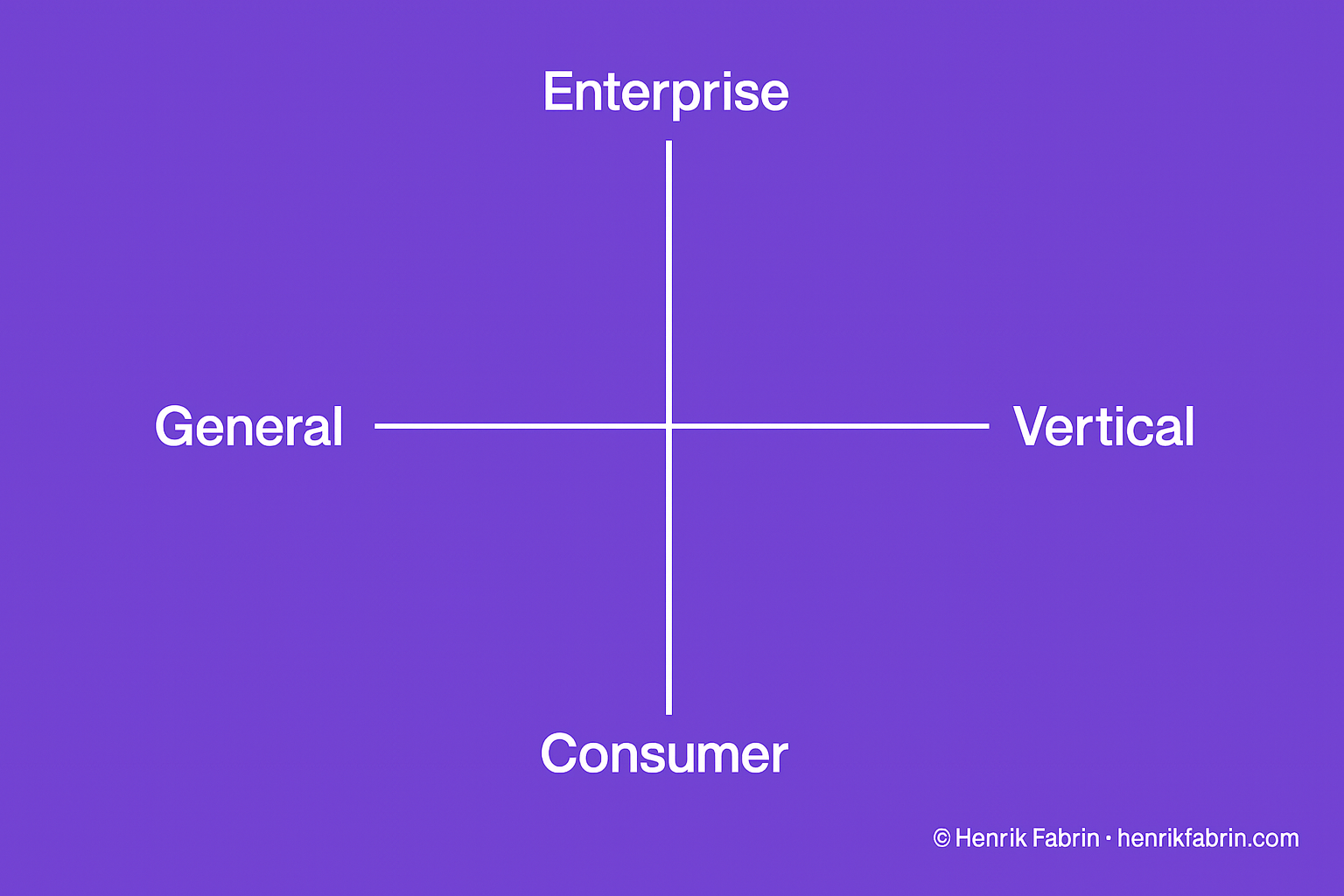
If we map today's AI market, four directions emerge. The horizontal axis runs from General to Vertical (from broad-purpose models like ChatGPT to domain-specific or culturally tuned tools like Zalando, Corti, Doculyze, or Claibe). The vertical axis runs from Enterprise to Consumer (from AI used at work to AI used in everyday life).
Most global attention sits in the upper-left quadrant (general AI for enterprises and consumers), dominated by U.S. and Chinese players. Europe's strengths cluster on the right-hand side: vertical AI for both enterprises and consumers, where local fluency, trust, and regulation create defensible value. And one quadrant remains wide open (the general consumer experience).
That's the opportunity: to keep deepening our vertical strength while building outward into the general layer that connects it all.
From vertical depth to a general European layer
Starting with vertical strength
Europe's advantage in AI starts deep (in the verticals). That depth isn't a limitation; it's how ecosystems mature. The goal isn't to move away from it, but to build on it and extend that strength into everyday life.
Vertical AI creates adoption and trust. Systems built for real sectors (healthcare, finance, education, construction) earn credibility because they solve regulated, real-world problems. They integrate with national infrastructure like identity and payments, and serve people in their daily work. When millions already rely on European-built AI at work, extending that trust into consumer life becomes natural. People trust what already helps them work.
Each of these vertical systems also captures structured, high-quality knowledge (how we diagnose, document, plan, and decide). They learn European languages, workflows, and ethics, creating a library of behaviours and standards that can feed into broader systems. In other words, Europe's verticals are already teaching AI how Europe works.
The alignment layer connects it all
When these systems are connected through shared standards and governance (the alignment layer), three things follow:
- Portability of data and memory across contexts
- Consistency in how trust and safety travel with users
- Reach through simpler, more universal interfaces
This is how Europe can scale its existing trust advantage into a connected AI ecosystem.
Building the general layer
From there, the general layer emerges naturally. A European consumer AI can grow organically out of the systems people already use and trust. It won't need to declare its values (they'll be built in). That's how vertical depth becomes the springboard for a general layer that feels European not because of branding, but because of how it behaves.
That "European layer" could materialise in two forms: as an open ecosystem where multiple assistants, copilots, and consumer products interoperate; or as a flagship experience (a general AI assistant or suite that sits on top of that ecosystem and makes it tangible for users). Both reinforce the aggregation dynamic: the more that data, learning, and alignment flow through shared European standards, the more defensible the ecosystem becomes (regardless of whether users experience it as one app or many).
Learning from platform evolution
This isn't new. Every major platform shift followed the same curve: enterprise first, consumer later; specific use cases first, general layer later. The web evolved from specialised sites (commerce, publishing) to broad platforms like Google and Facebook that unified access. AI will follow the same pattern. Europe's edge is that our base already rests on trust, governance, and multilingual reality. When the general layer arrives, it can be safer, more aligned, and more locally resonant by default.
"And this time, Europe can connect the dots differently. Aggregation, not consolidation, is our strategy. The alignment layer is how we turn diversity into defensibility (linking the systems we already trust into one coherent experience). If we build that layer ourselves, we avoid repeating the dependency loop from Part 1 (keeping both our depth and direction within European control)."
The mindset shift (compete differently)
For too long we've asked: "Can we catch up?"
The better question is: "How do we compete differently?"
- •Measure success in usefulness, quality, and adoption, not model size.
- •Compete on localization and cultural fluency: AI that speaks your language, understands your sector, and works the way you work beats generic scale.
- •Treat coordination as an advantage, not bureaucracy.
- •Use governance to accelerate sales cycles and trust, not to slow shipping.
- •Market liveability as part of the offer to founders and teams, not an afterthought.
This is how Europe moves from dependency to direction without pretending to be something we're not.
Direction, stated simply
If Europe wants control over its AI future, here's the directional choice:
- •Use regulation surgically: where it creates clarity, trust, and open markets, and streamline where it blocks experimentation and scaling.
- •Deliver an EU-INC-style on-ramp so formation and cross-border growth are default-simple.
- •Coordinate an alignment mindset across institutions so we decide how AI behaves here (and how value circulates) even when we use global models.
- •Invest together in compute, open models, shared evaluation datasets, and data trusts: the common goods that raise everyone's floor.
- •Build for local depth, not just global reach: Support AI that understands European languages, sectors, work cultures, and contexts: because precision at the edge beats generic prompts at scale.
- •Play to our strengths: trust, localization, governance quality, diversity at scale, and quality of life: because they are the conditions for durable leadership.
In short, direction means building the connective tissue of sovereignty, and in Part 3 we'll turn that alignment mindset into actual software and product design.
Do this, and Europe stops being the world's largest AI customer and becomes the region that defines how AI behaves: responsibly, competitively, and at scale.
From direction to design
This article explored the direction: why Europe's structural advantages (trust, coordination, diversity, liveability) create a realistic path to AI sovereignty when we compete differently rather than imitate.
But direction without execution is just strategy. In Part 3, we turn that direction into design: the alignment layer as a design framework, the three strategic use cases, and how product decisions make sovereigntyfelt by people every day.
Read next: Part 3 - From Direction to Design →