Europe is adopting AI at record speed, but mostly on U.S.-owned platforms. That creates a growing dependency in both the consumer interface (AI chatbots like ChatGPT, Gemini, Grok, Meta) and the enterprise stack (cloud, models, copilots, agents). If we don't adjust course, Europe risks becoming the world's largest AI customer rather than its producer: exporting data and value while importing capability.
Europe sits at the application edge of an American AI stack: U.S. infrastructure, U.S. models, U.S. interfaces. Our data and spend move upward through these layers; our influence and margins move outward.
The adoption wave is real and still rising
In less than three years, ChatGPT has reached over 41 million users in Europe, a pace of adoption the internet and smartphones never achieved.
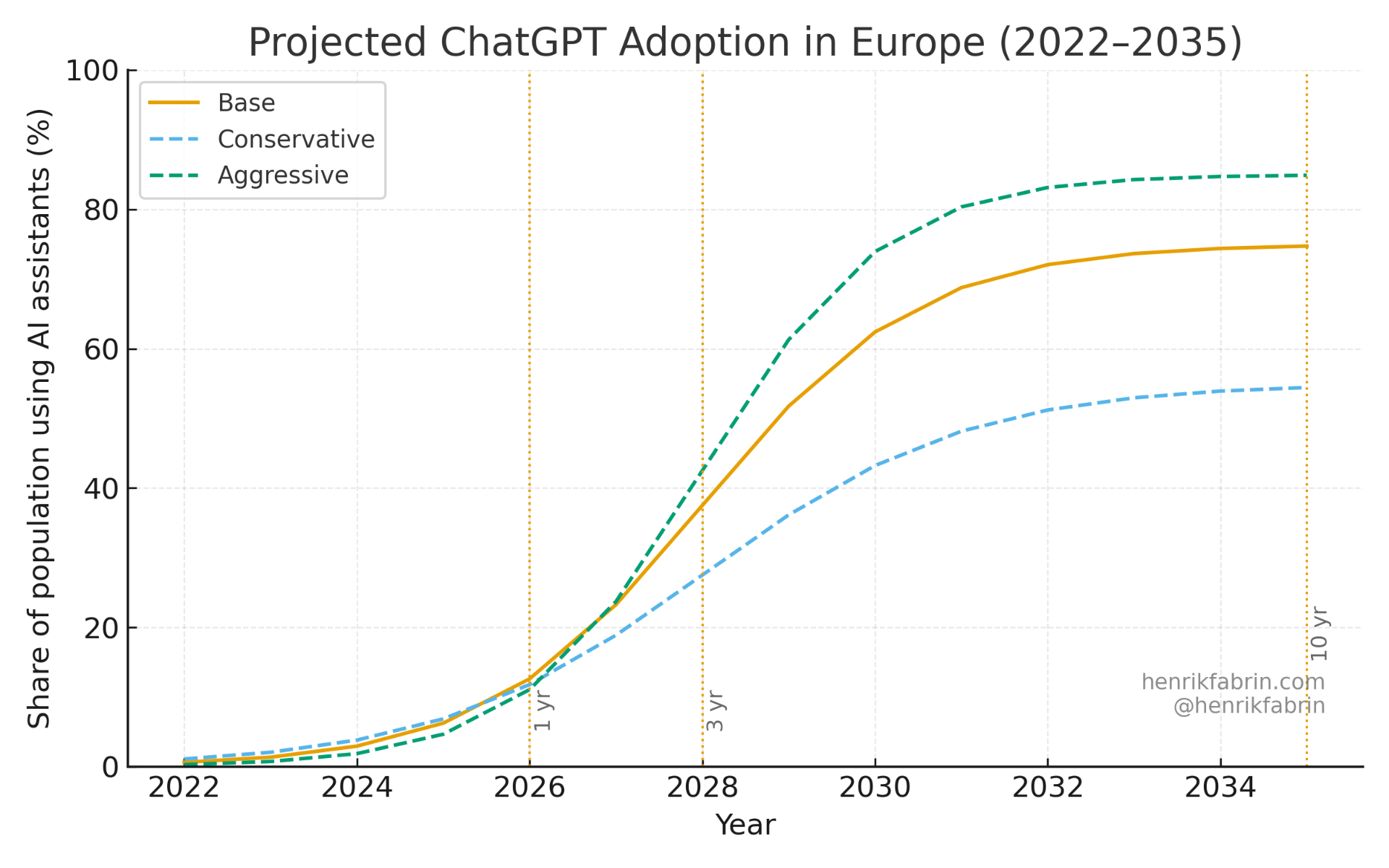
Enterprise adoption is tracking a similar S-curve. Today's usage is uneven (large companies ahead of SMEs), but the direction is unmistakable.
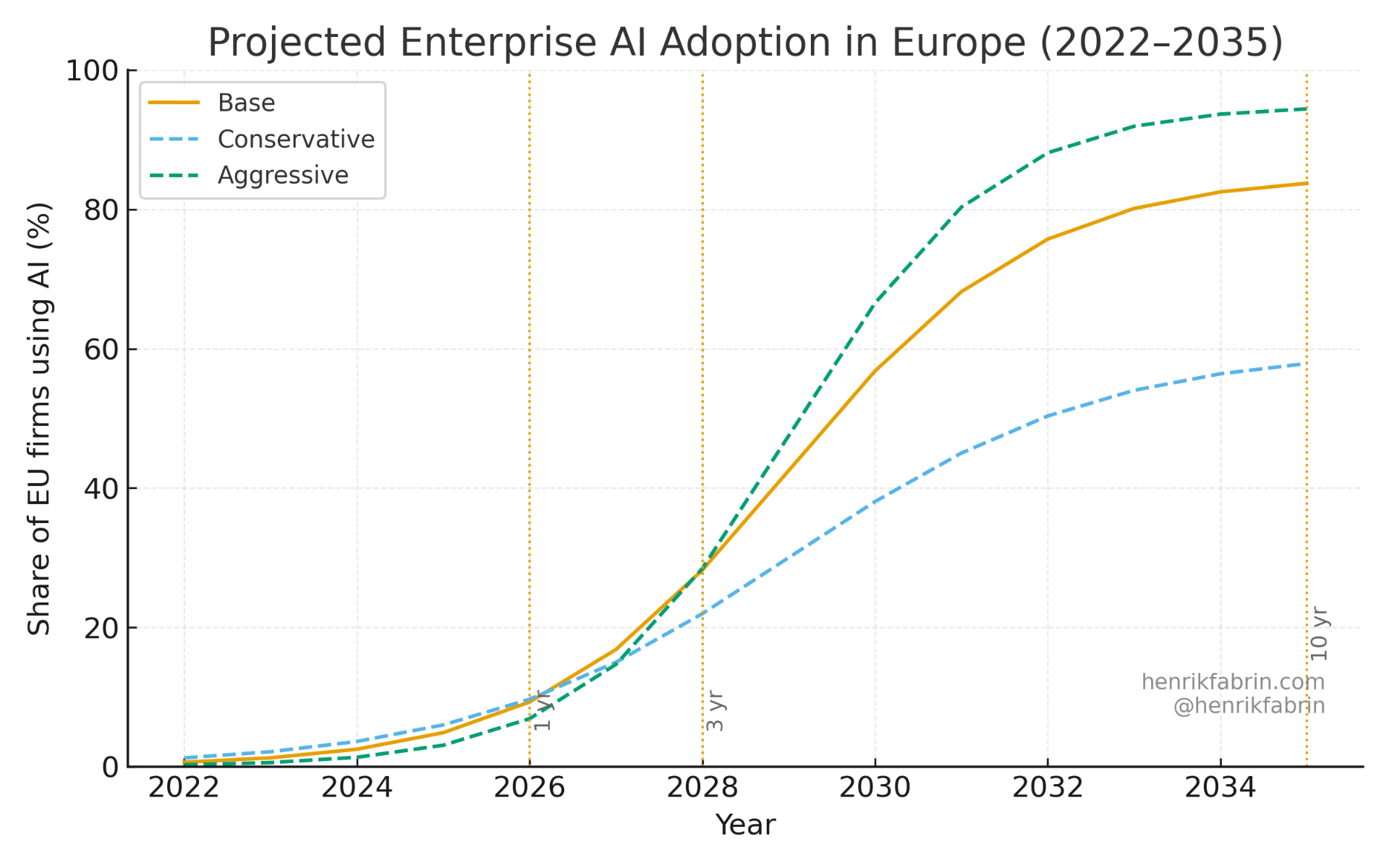
Why these two charts matter together: They're the demand side. When both citizens and firms normalize AI in daily life and work, data, decisions, and distribution start flowing through the providers of those AI layers.
When adoption outpaces ownership, value follows data, and sovereignty erodes as a second-order effect.
From adoption to monetization: where the money goes
To understand value capture, I projected revenue for the most visible consumer and enterprise players.
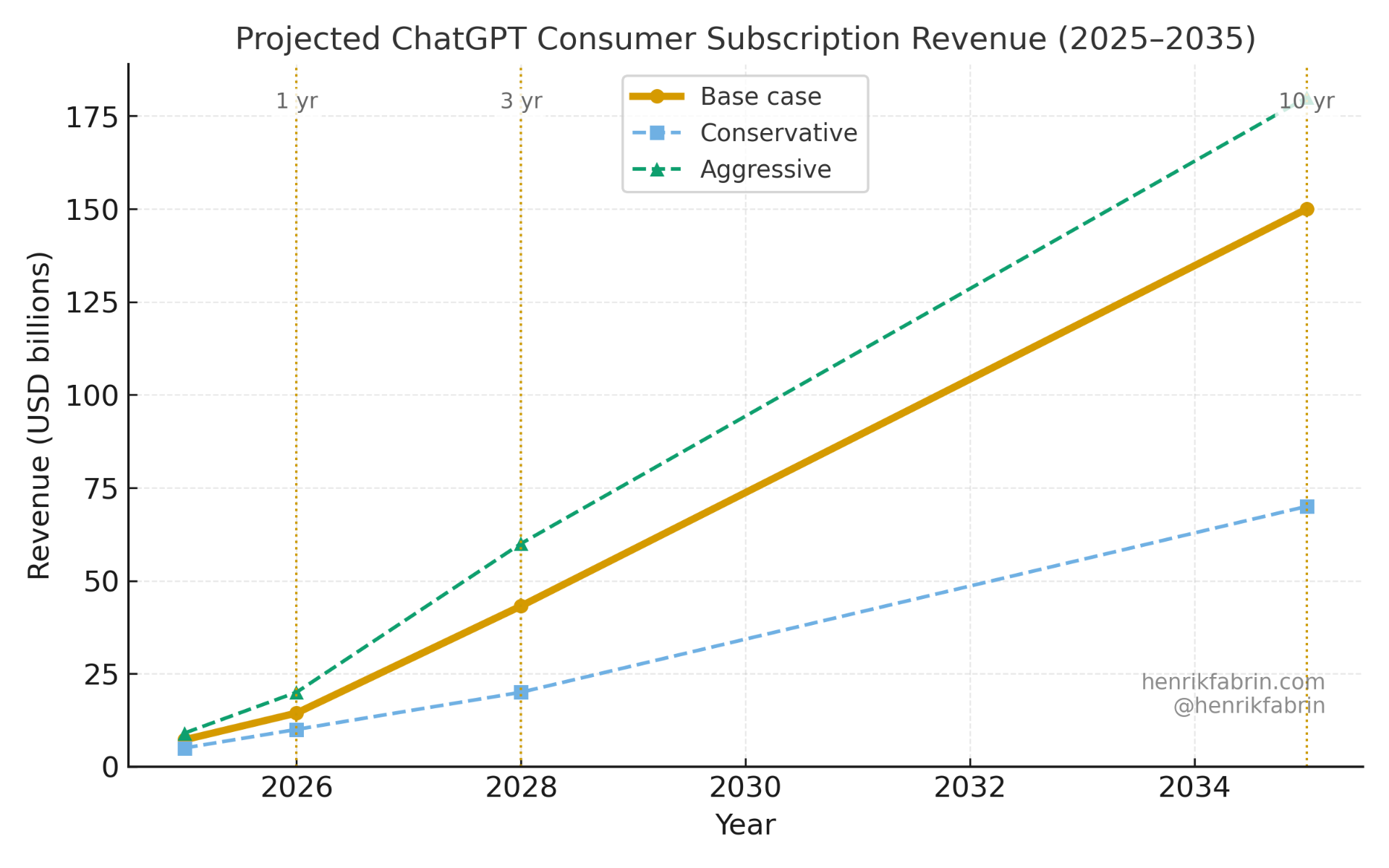
ChatGPT: consumer subscription revenue
- I combine public run-rate reports (2025) with realistic growth scenarios and the 1-3-10 horizon.
- This captures paid subscriptions, not ads or generic traffic.
OpenAI: enterprise & API revenue
- Anchored to the OpenAI CFO's statement (≈75% revenue from consumers → ≈25% enterprise/API) and an overall $12B annualized run-rate in 2025.
- I then project enterprise/API growth along the 1–3–10 arc.
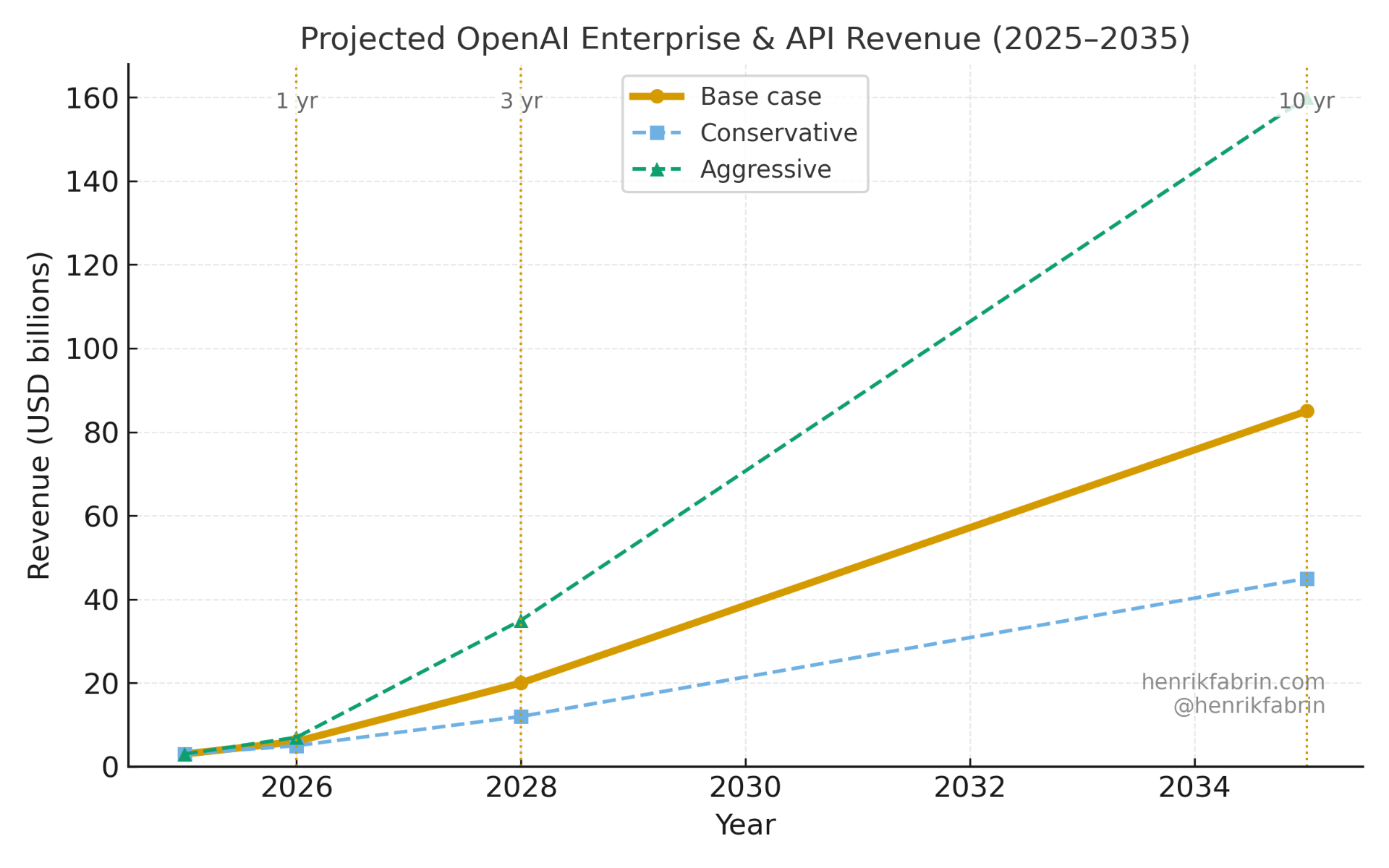
What these curves imply for Europe: When adoption ≫ local supply, monetization accrues to whoever provides the platform. Today, that's overwhelmingly U.S. companies. Even when European companies customize or integrate, the core economics (subscriptions, API calls, infrastructure) are captured upstream.
The dependency pattern: consumer and enterprise reinforce each other
These two layers aren't separate markets; they reinforce each other. Consumer use fuels data generation and familiarity; enterprise use turns that data into productivity and margin.
- Consumer side: Assistants and agents (ChatGPT/Gemini/Claude) become the default interface for search, health, personal development, planning, and micro-work. Each step draws personal data and behavioral insight into non-European ecosystems.
- Enterprise side: Copilots, agents and AI APIs embed into productivity suites, CRMs, ERPs, code repos, and customer channels, pulling operational data and workflows into the same ecosystems.
- Result: Europe exports data and demand, imports capability and margins.
"Europe risks becoming the world's biggest AI customer, not its producer."
This dependency doesn't just shift profits abroad; it limits policy leverage, distorts local competition, and slows the feedback loops that improve European products.
Denmark as a microcosm of the EU paradox
Denmark is Europe in miniature: high adoption, low strategic use, showing how curiosity without coordination breeds dependency.
- 70% of Danish firms have experimented with AI; ~7% use it strategically.
- SMEs don't lack curiosity; they lack direction and guardrails for strategic use.
- If we only teach SMEs to use convenience defaults (e.g., Copilot/ChatGPT over open + European options), we train dependency, not competitiveness.
Key distinction for SMEs:
We're not asking SMEs to build AI; we're asking them to use AI wisely. The choice of which tools they adopt determines whether data stays in Europe, or value flows elsewhere.
The 1–3–10-year risk timeline (if nothing changes)
| Horizon | What likely happens |
|---|---|
| 1 year | Lock-in intensifies: Assistants, copilots and agents become the default interface; switching costs rise. |
| 3 years | Value & data gravity: Spending, data, and extensions are concentrated in non-European ecosystems. |
| 10 years | Structural dependency: Productivity gains and platform margins accrue mostly outside Europe; regulation has limited leverage. |
What "success by 2035" should look like (the scoreboard)
By 2035, Europe can be the world's most trusted AI economy: sovereign, open, and competitive.
I'll detail solutions in a separate post; here's the destination you can measure:
- •≥ 85% of firms using AI (≥ 95% of large firms).
- •≥ 95% of citizens using AI.
- •≥ 50% of EU AI value captured by EU-owned platforms and vendors.
- •≥ 25% of global AI compute hosted in Europe (≈10–12 GW by 2035).
- •≥ 25 EU companies among the world's top 100 AI firms.
- •SMEs using AI daily without handing over critical data or customer insight abroad.
What's next
This article is the first in a three-part series on Europe's AI trajectory: from dependency to design.
Post 1: The problem (dependency) - You're reading it now.
Post 2: The direction (how Europe can act) - The following post shifts from problem to direction: how Europe can leverage its strengths in trust, governance, and collaboration to regain control of the AI future.
Post 3: The execution (roadmap, product, UX principles) - The final post will turn that direction into execution: a sovereign-by-design roadmap for how European businesses and citizens can use AI at scale without losing control; from product and UX principles to market strategies that make those ideas real.
Together, the three posts form one story:
How Europe can turn sovereignty into strategy - and strategy into software
What's Next: From Problem to Direction
This article diagnosed Europe's AI dependency: how adoption is soaring while value capture flows abroad. But dependency isn't destiny.
In Part 2, I shift from diagnosis to direction: how Europe can leverage its structural strengths in trust, coordination, and quality of life to compete differently and regain control of the AI future.
Read next: Part 2 - How Europe Can Act →Download the charts (for your site/SoMe)
- Consumer adoption (Europe): PNG
- Enterprise adoption (Europe): PNG
- ChatGPT consumer subscription revenue: PNG
- OpenAI enterprise & API revenue: PNG
Methodology & assumptions (brief)
- Adoption projections: Logistic (S-curve) diffusion fitted to current European usage signals and enterprise surveys (Eurostat/DESI).
- Revenue projections:
- Consumer: "ChatGPT consumer subscription revenue" = paid Plus/Pro/Teams accounts. Scenarios extrapolate from 2025 run-rates.
- Enterprise/API: Based on OpenAI CFO stating ~75% consumer share → enterprise/API ≈25% of total revenue; scaled with enterprise S-curve.
- Compute target: EU share < 5% today; 25% by 2035 implies ≈ 10–12 GW EU AI/HPC capacity if global reaches ~45–50 GW.
Sources (selection)
- Bloomberg (Oct 2024): OpenAI CFO states ~75% of revenue from paying consumers (ChatGPT subscriptions).
- Reuters (Jun 2025): OpenAI reaches $12B annualized revenue.
- GlobalTradeMag (2025): OpenAI revenue breakdown and growth trends.
- SQMagazine (2025): Estimated ARPU for ChatGPT Plus (~$8.9/month).
- Eurostat / DESI (2024): EU enterprise AI adoption (~13.5% overall; ~41% large firms).
- IDC (2024): Europe AI spend outlook (towards ~$144.6B by 2028).
- OECD & McKinsey (2023–2024): Macroeconomic impact estimates for AI in Europe.
- European Commission "AI Made in Europe", EuroHPC capacity data, and NVIDIA/Mistral: EU compute share baseline and 2035 targets; global AI compute projections.
- Danish Industry (DI) and AI for All: Danish firm AI adoption data (~70% experimented; ~7% strategic use).