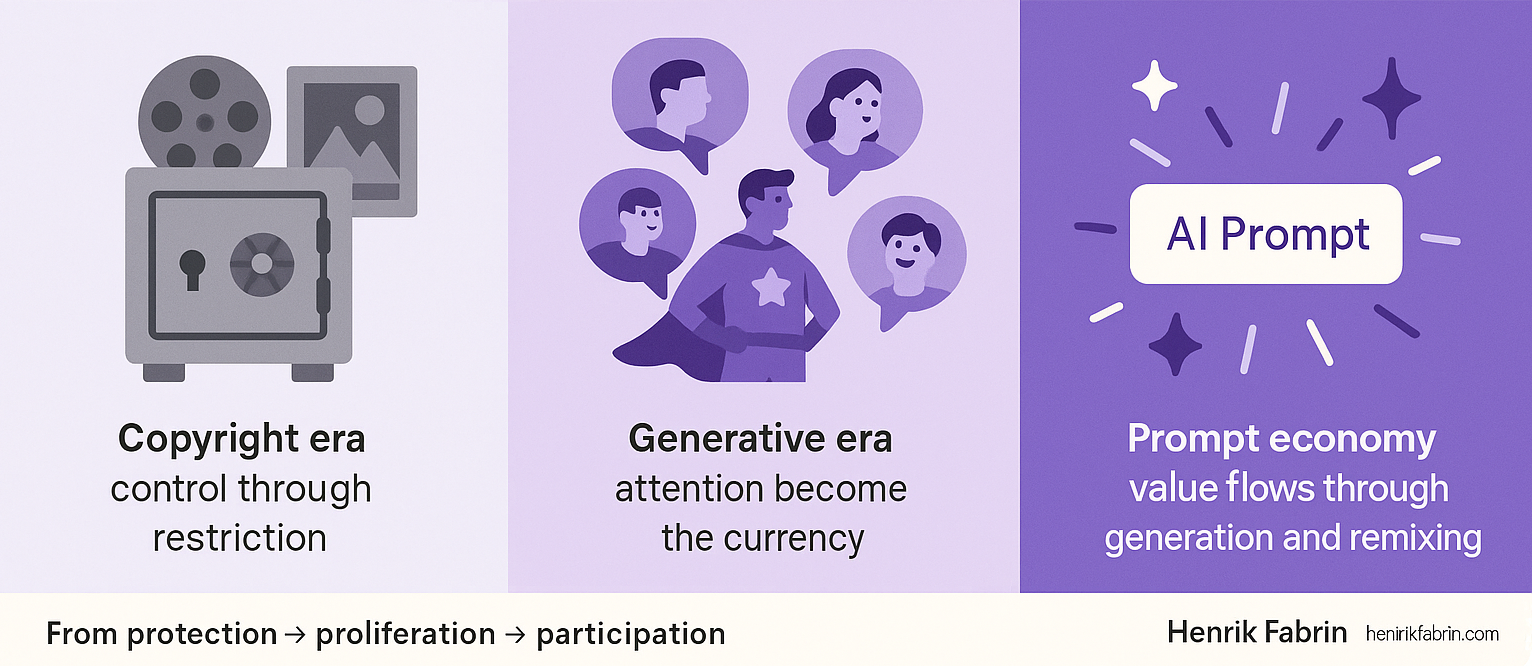
When AI becomes the world's biggest storytelling machine, the real competition won't be at the box office; it'll be in your imagination.
The thesis
In the age of AI-generated content, intellectual property owners will start competing not to protect their characters, but to make them go viral.
The most valuable IP won't be the one locked behind legal fences; it'll be the one people use the most when creating stories, videos, and memes with AI.
From protection to proliferation
For over a century, copyright has been a fortress: guard your characters, sue the imitators, control every adaptation.
That logic made sense when content creation required cameras, studios, and budgets.
But now, anyone with a phone can generate an entire movie trailer, comic book, or TikTok skit in seconds, featuring any character, real or imagined.
In this new world, the scarce resource isn't content. It's attention.
And the most powerful way to capture it isn't to stop people from using your characters; it's to make sure your characters are used everywhere.
The attention economy becomes the generation economy
Every time someone types a prompt like "make a short film about two rival heroes in a futuristic city", they're pulling from a cultural memory bank.
If that bank mostly contains one company's characters, worlds, and visual language, that company wins.
Imagine DC and Marvel not competing at the cinema, but in the prompt box.
If people generate 100x more Spider-Man scenes than Batman scenes, Marvel wins cultural mindshare.
And cultural mindshare drives everything else: merchandise, games, streaming, and ticket sales.
AI generation turns fan creativity into free distribution.
What's happening right now
We're already seeing early skirmishes in this new IP war, played out in courtrooms instead of prompt boxes.
- Disney & Universal vs. Midjourney (2025):
In June 2025, Disney and Universal sued AI image generator Midjourney, claiming it produced unauthorized depictions of their characters, from Minions to Marvel heroes, using datasets scraped from copyrighted material. Their argument? Midjourney was a "virtual vending machine" for infringing art. Midjourney's defense? It doesn't store the art; it learns from it. - Warner Bros. Discovery vs. Midjourney (2025):
In September, Warner Bros. Discovery filed its own lawsuit, alleging "systematic, willful" infringement. They even showed AI-generated images of Superman, Batman, and Scooby-Doo as evidence.
These lawsuits aren't just legal skirmishes. They're negotiations about the future.
Each one signals the same thing: the value of IP in the generative age lies not in restriction, but in integration.
From litigation to licensing
Behind the courtroom drama, a new business model is emerging.
Instead of fighting AI platforms, some studios are starting to license their IP for use in AI models, embedding official character data, metadata, and style guides.
Soon, we may see:
- Character APIs: official endpoints for generating stories or visuals featuring licensed worlds.
- Revenue-share models: every time a user's AI creation includes your IP, a micro-royalty flows back.
- Creator programs: fans rewarded for making AI-generated content that drives brand engagement.
The future might look less like "cease and desist," and more like "prompt and profit."
Measuring cultural share
In the generation economy, brand awareness becomes algorithmic.
Instead of Nielsen ratings, IP owners might track:
"How often is my character used in AI prompts worldwide this week?"
Prompt frequency becomes the new KPI.
Studios will want to see their universes trending across Midjourney, Runway, and ChatGPT, not because they're losing control, but because being in the feed means staying relevant.
This is synthetic mindshare: cultural dominance measured by how many machines (and humans) imagine you.
Why this matters
Like Shopify democratized entrepreneurship, generative AI democratizes storytelling.
Everyone can now play studio head, director, or writer, and every story they make becomes a tiny piece of cultural marketing.
The question for IP owners isn't "how do we stop it?" but "how do we ride it?"
Whoever figures out how to let fans co-create responsibly, without losing brand integrity, will own the next decade of entertainment.
Because in the future, the most valuable IP won't just be seen; it'll be generated.
The infrastructure question
This essay explored the cultural shift: how IP and creative identities will compete for mindshare in AI systems. But there's a practical question underneath: how does that competition actually work?
When someone types "write like Hemingway" or "design like Dieter Rams," value is being created and transferred. But today, none of it flows back to the people who built those styles.
For this new IP war to be sustainable, we need market rails: infrastructure that lets skills, methods, and creative DNA be packaged, distributed, and paid for inside AI systems.
Read next: The Market Engine →