"AI slop is a good thing."
That sentence jars. But once you sit with it, I think you'll find it captures something essential: in the era of generative AI, a flood of low-quality output isn't just inevitable, it's the signature of democratization. And democratization is often messy, noisy, and full of failure - but also full of possibility.
A new analysis by Graphite shows that in 2025, AI-generated content officially surpassed human-generated content for the first time.
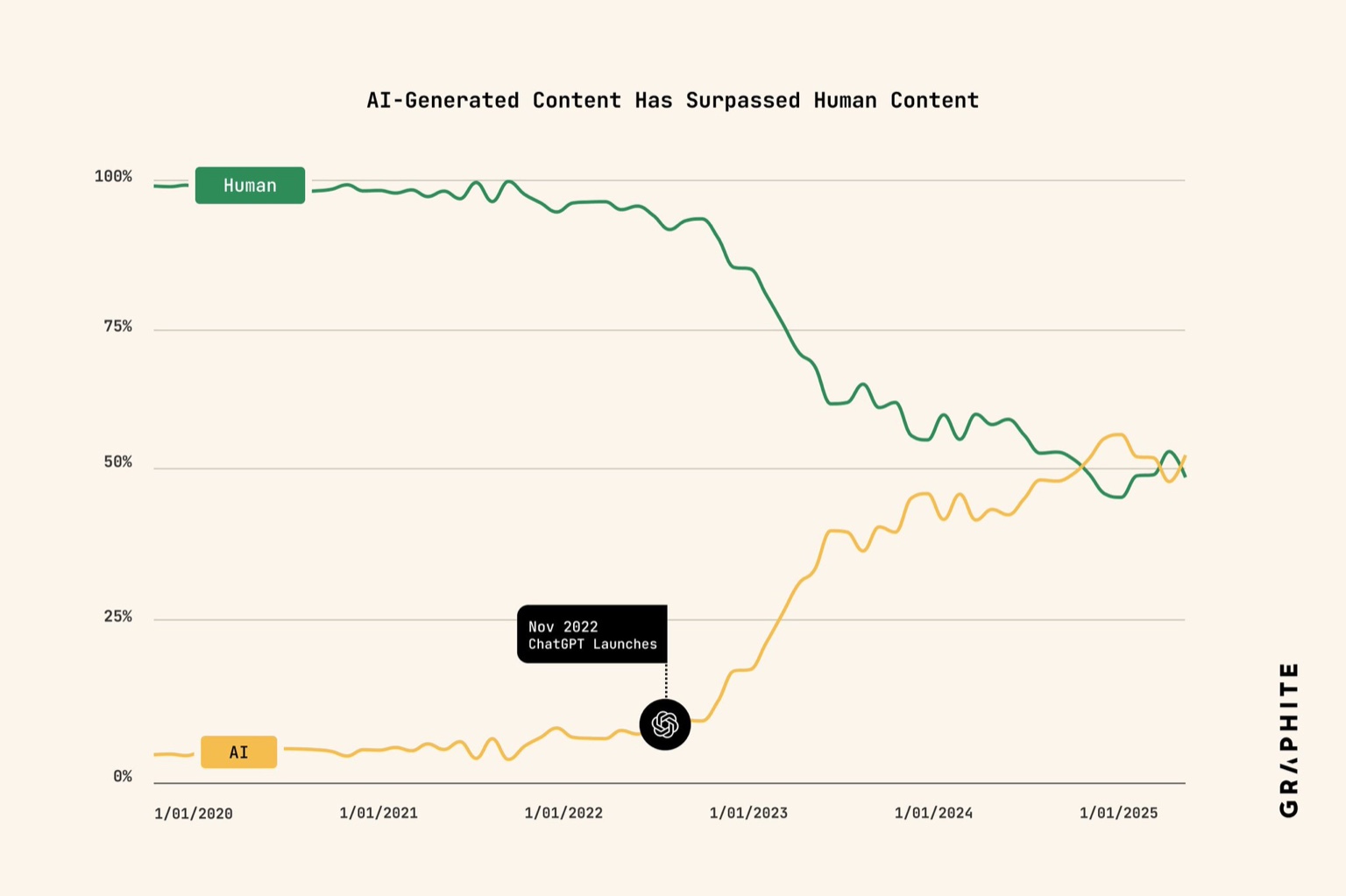
Source: Graphite (2025)
The implications are enormous: we've crossed a threshold where the majority of the world's written, visual, and even audio content is now algorithmically generated. That sounds alarming - but it also means more people than ever have access to tools that let them express themselves. That's the messy, noisy, democratizing power I call "AI slop."
Below, I lay out the argument in the fullness of its parts: the thesis, the analogy, the upside, the risks, and the guardrails. The goal is to show why I believe "slop" is a necessary stage on the path to a more inclusive creative ecosystem.
1. The core thesis
When a powerful new tool becomes cheap, accessible, and easy, the first wave of output will be unrefined. In fact, that is precisely how creative revolutions begin. The question is: does that flood of mediocrity lead us into chaos or into a richer, more participatory realm?
I contend: in net, it leads to the latter. Because what we trade (more noise, more filtering effort) is more than made up for by what we gain: a lower barrier to expression, more diversity of voices, more experimentation, and new opportunities to find value in the long tail.
The alternative - insisting on purity or restriction at the gates - risks restoring the very barriers that generative AI was supposed to dismantle.
2. The Shopify analogy: how we democratized entrepreneurship
To understand the logic, it helps to recall Shopify's story.
- Before platforms like Shopify, launching an online store required technical setup, web coding, shopping cart infrastructure, hosting, payment gateways, security, design, all of which imposed high fixed costs.
- Shopify removed much of that friction, enabling "anyone with a product idea" to launch a webshop in hours.
- As a result, we saw an explosion of small, early-stage shops, many of them small, many of them unsuccessful, many of them quirky or unpolished.
- But from that sea of attempts, new business models emerged, surprising hits were discovered, and entrepreneurs who would never have attempted before got to test the waters.
Shopify itself leans into the metaphor:
"We must democratize entrepreneurship, making it an accessible and viable path for anyone with a vision." Shopify
And the data bears it out: in neighborhoods with more underrepresented groups, there is a measurable uptick in Shopify-powered new ventures. London Business School
Yes, many of those ventures fail or remain tiny. But that is precisely the point: the opportunity to try is itself a social good.
Generative AI is doing for creative expression (writing, design, ideation, art, prototyping) what Shopify did for commerce. The "slop" is analogous to thousands of small shops; many aren't sustainable, but some are seeds of something unexpected.
3. What slop buys us - the upside of noise
Here are the main gains I see when we accept and work with the slop, rather than fight it.
Lowering the barrier to entry
Generative AI tools now let non-specialists generate drafts, visuals, prompts, or prototypes. You don't need deep training in design, writing, or coding to start. In effect, many more people can try.
TechTarget describes this shift as AI democratization: putting AI into the hands of users without specialized technical knowledge.
Open-source or low-code models further extend that reach. Carnegie Council
This is not just convenience; it's about empowerment.
Experimentation, iteration, and risk-taking
When cost-of-entry is low, risk-taking increases. More people will try ideas, pivot, discard, refine. The creative process becomes more fluid, more scalable. Even bad drafts or weird mashups become stepping stones.
In software, McKinsey notes that AI is changing how products are built, reducing time spent on routine tasks and freeing teams to explore more creative directions.
Likewise, in artistic or content domains, the "slop" is raw dust to be polished or ideas to remix.
Diversity of voices and perspectives
One of the major structural barriers in media, publishing, art, and content is gatekeeping. Access (platforms, distribution, editing, reputational networks) is concentrated. Gen AI lowers those gates.
So you get voices from geographies, communities, or social strata that never had channels before. Yes, the output will often be rough - but roughness should not be the filter. The filtering should come afterward.
Moreover, giving more creators tools shifts some power away from large institutions (publishers, agencies, studios) toward the periphery.
Market expansion and new demand strata
Contrary to doomsayer narratives of wholesale replacement, early evidence suggests generative AI often expands markets by serving lower tiers of demand that had previously been unserved or underserved.
For instance, an analysis of image-generation markets found that cheaper, lower-grade output increases volume and services for casual or personal use, while incumbents still hold onto higher-end clients. Shopify
In other words: slop doesn't always cannibalize high-end creators; it can enable a two-tier structure where new use-cases and niches appear.
4. The risks, the counterarguments, and how they matter
Of course, no argument is complete without confronting pushback. Here are the biggest risks - and my take on them.
Signal-to-noise collapse and discoverability
If every mediocre idea can be produced easily, filtering becomes a huge challenge. Platforms will struggle with signal-to-noise ratios. If we don't solve for curation, people will gravitate toward the loudest or flashiest, not the best.
This risk means that platforms, search engines, and aggregators will have to evolve their ranking, quality detection, and reputational signals.
Disinformation, propaganda, and trust erosion
Cheap content generation can be weaponized: fake news, deepfakes, astroturfing, manipulative messaging. The more every voice can create "content," the easier it is to flood public discourse with lies. The Journal of Democracy warns of this "meaningless drivel" undermining democratic discourse.
Harvard's Bruce Schneier extends this risk beyond disinformation - AI shifts not just volume and fidelity, but speed, scope, and sophistication of influence. Ash Center
Thus, the democratization of generation must be met with stronger checks in discourse domains (politics, journalism, public health, etc.).
Quality degradation, cultural drift, and normalization of mediocrity
If a lot of content hovers at the threshold of "good enough," over time, the standard may shift downward. Mediocrity becomes the norm. That's a cultural risk: tastes might flatten or attention spans might shrink.
The only defense is to maintain or uplift curation, exemplars, and taste leadership.
Concentration, inequality, and bias amplification
Despite democratizing output, the backbone of powerful AI models - compute, infrastructure, data - is still concentrated in a few large firms and institutions. This "compute divide" means not everyone has the same ability to train or fine-tune advanced models. arXiv
Moreover, AI systems can encode and magnify bias in their training data. Marginalized groups may find their aesthetics, idioms, or cultural forms poorly represented or mischaracterized. NCBI
If democratization is superficial (output-level only), the deeper power asymmetries may persist or worsen.
Attribution, IP, and creator rights
Generative AI often uses scraped data and obscure training provenance. Many existing creators worry about loss of attribution, revenue, or control. As models co-opt styles, the line between human and machine becomes blurred.
This tension is already playing out in high-stakes lawsuits between major studios and AI platforms - a preview of how IP strategy itself may need to shift from protection to proliferation.
The legal, ethical, and financial infrastructure around AI ownership is still nascent, and creators' rights will be contested.
5. Guardrails, architectures, and norms to manage the slop
To make "slop" sustainable, we must design systems that channel it rather than repress it. That means not only better technology, but also better taste. i.e. the human layer that teaches, curates, and refines. Here are levers we (collectively) should work on:
1. Teaching what good looks like
In a world where creation is cheap and abundant, craftsmanship becomes the differentiator.
Anyone can now produce an idea, a design, or a draft in seconds. But only a few pieces cut through the noise. That difference comes down to understanding the craft - understanding what makes something good, what gives it structure, visual framing, rhythm, and emotional pull.
If AI lowers the barrier to creating, then taste and understanding become the new creative superpowers. We need to help users see why something works, not to gatekeep, but to teach the invisible skills behind good ideas.
Because when more people understand what good looks like (to them individually), the average rises. "AI slop" becomes the raw material for better craft.
2. Provenance, watermarking, metadata & transparency
AI outputs should carry origin metadata so consumers, platforms, and institutions can trace whether a piece was human, AI-assisted, or fully AI-generated. (Or if most content is AI-generated, perhaps it is better to mark human content?)
3. Reputation, credibility, and boosting signals
Platforms should rank not just by clicks but by signals of trust: author history, peer reviews, curation, editorial validation, community upvotes, and verified status.
4. Tiered rules in sensitive domains
In domains like politics, health, science, and journalism, use stricter rules (disclosure, fact-checking, curated oversight) than in casual expressive domains.
5. New models of creator compensation & licensing
Micropayments, licensing schemes, revenue-sharing, or attribution markets could help creators be recognized and rewarded even when AI intercedes.
In fact, some IP owners are already exploring licensing deals with AI platforms instead of purely fighting them in court - turning potential infringement into new revenue streams.
6. Hybrid workflows (AI + human in loop)
Rather than full automation, many value paths will be hybrid: AI generates drafts, humans polish or curate. The slop is raw material, not final product.
7. Governance, openness, and public AI options
We should push not only for democratization of use but democratization of governance - public input into how AI is built and deployed. Some propose public AI models (akin to "public roads" or "postal systems") to serve as baseline platforms. Brookings
Also, data trusts or shared ownership of training corpora can help distribute value and oversight. arXiv
6. Why I believe the net is positive and why you should care
When I weigh the benefits and costs, I lean decisively toward the net-positive side. Here's why:
- Restoring agency to the many. The question isn't whether content will be messy; it's who gets to mess. If we restrict generation, we risk returning gatekeeper power to institutions.
- Unearthed surprises. From among slop often emerge gems, unexpected voices, fresh styles. If you limit experiments, you lose discovery.
- Differentiation still matters. Great creators, curators, and editors will still matter. In a denser ecosystem, excellence will outcompete noise - but it requires new skill (curation, brand, reputation).
- Tail-side value emerges. Many use-cases are small, personal, niche - and slop might suffice there. Meanwhile, premium creators can occupy the high end.
- Democratization accelerates innovation. Platforms like Shopify showed that democratizing infrastructure unleashes latent demand and latent entrepreneurs. I see generative AI doing the same for creativity.
To rephrase: I believe the messy middle is not the "end state"; it's the generative phase. Over time, filtering, norms, curation, and infrastructure improve. In the early phase, we must tolerate noise if we want to unlock the latent upside.