How national institutions can turn adoption into acceleration
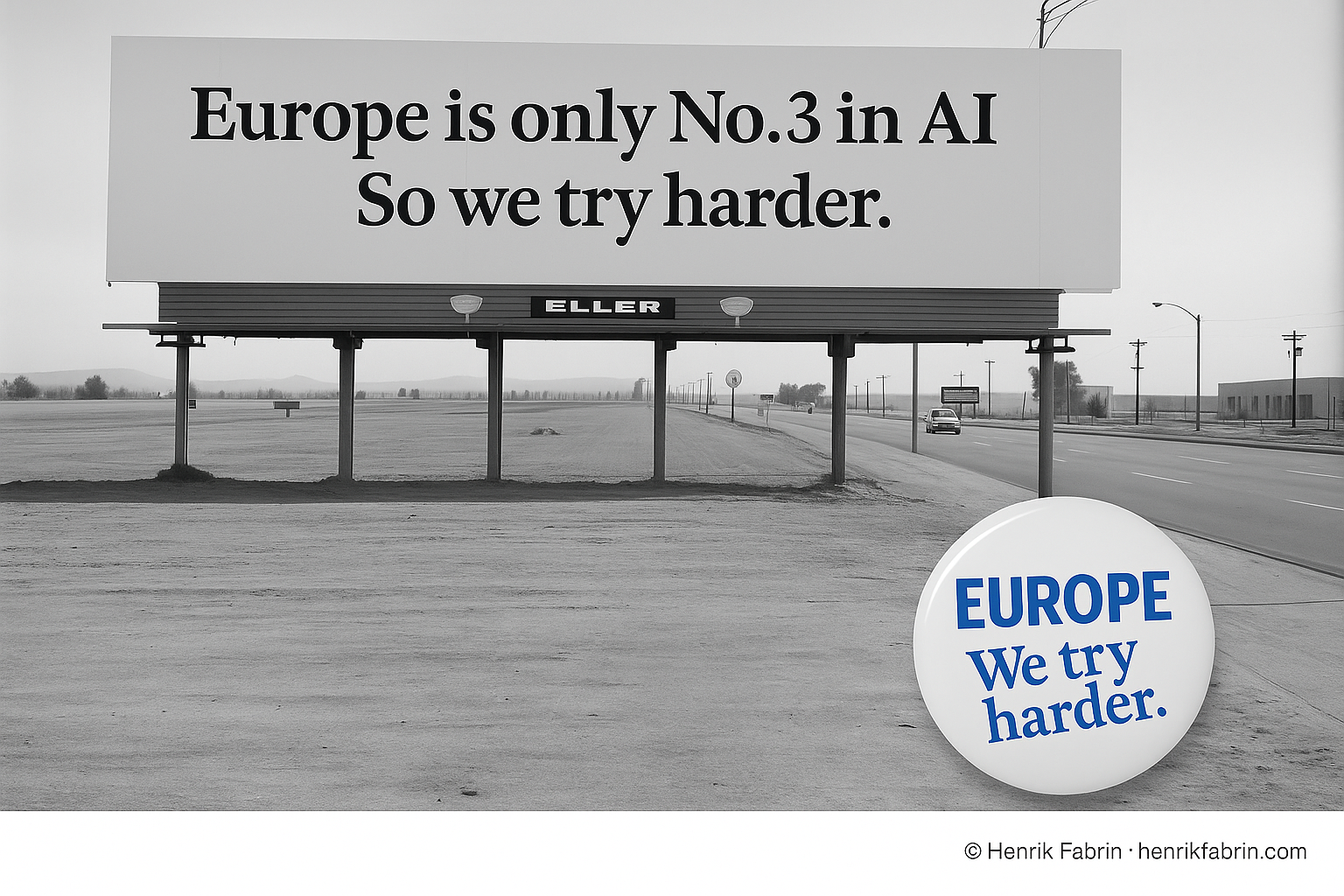
Europe may be #3 in AI, but it's where coordination can become a competitive edge
Across Europe, millions of small and midsized companies are ready to use AI, but many still need help figuring out where to start, what to trust, and how to scale.
At the same time, Europe's AI startups are building world-class solutions, often better aligned with local regulations, languages, and data realities, yet struggle to reach these very companies. And investors are eager to fund the startups solving real business problems, but lack visibility into where traction is happening.
That's where industry associations and public innovation agencies, like Danish Industry (DI) and the Danish Board of Business Development (DBBD), and their equivalents across Europe, can play a critical role. They can connect these three forces: helping companies adopt AI faster, helping startups grow, and helping investors spot real momentum.
The disconnect
When European SMEs look for AI tools, they often end up with global products such as ChatGPT, Microsoft Copilot, Notion AI, or Adobe Firefly: solutions that are easy to access, highly marketed, and instantly trusted.
They're excellent, but they also create a dependency loop: Europe becomes a user of AI technology, not a builder and market-maker for it.
Meanwhile, European startups develop specialized tools, often with deep domain focus, but struggle to find the customers and validation that can help them scale. Policymakers fund innovation generously, yet the bridge between R&D and commercial adoption remains thin.
The result isn't a lack of innovation or ambition: it's a lack of connection and coordination.
The opportunity
Institutions like DI, DBBD, and their peers across Europe can become that connection, the matchmaking and scaling infrastructure between:
- SMEs that need practical, affordable AI tools and trusted guidance.
- European AI startups that need customers, distribution, and feedback.
- Investors that need visibility into validated, growing companies.
This relationship can be visualized as Europe's AI Growth Triangle, where SMEs, AI startups, and investors form the three sides of a self-reinforcing ecosystem.
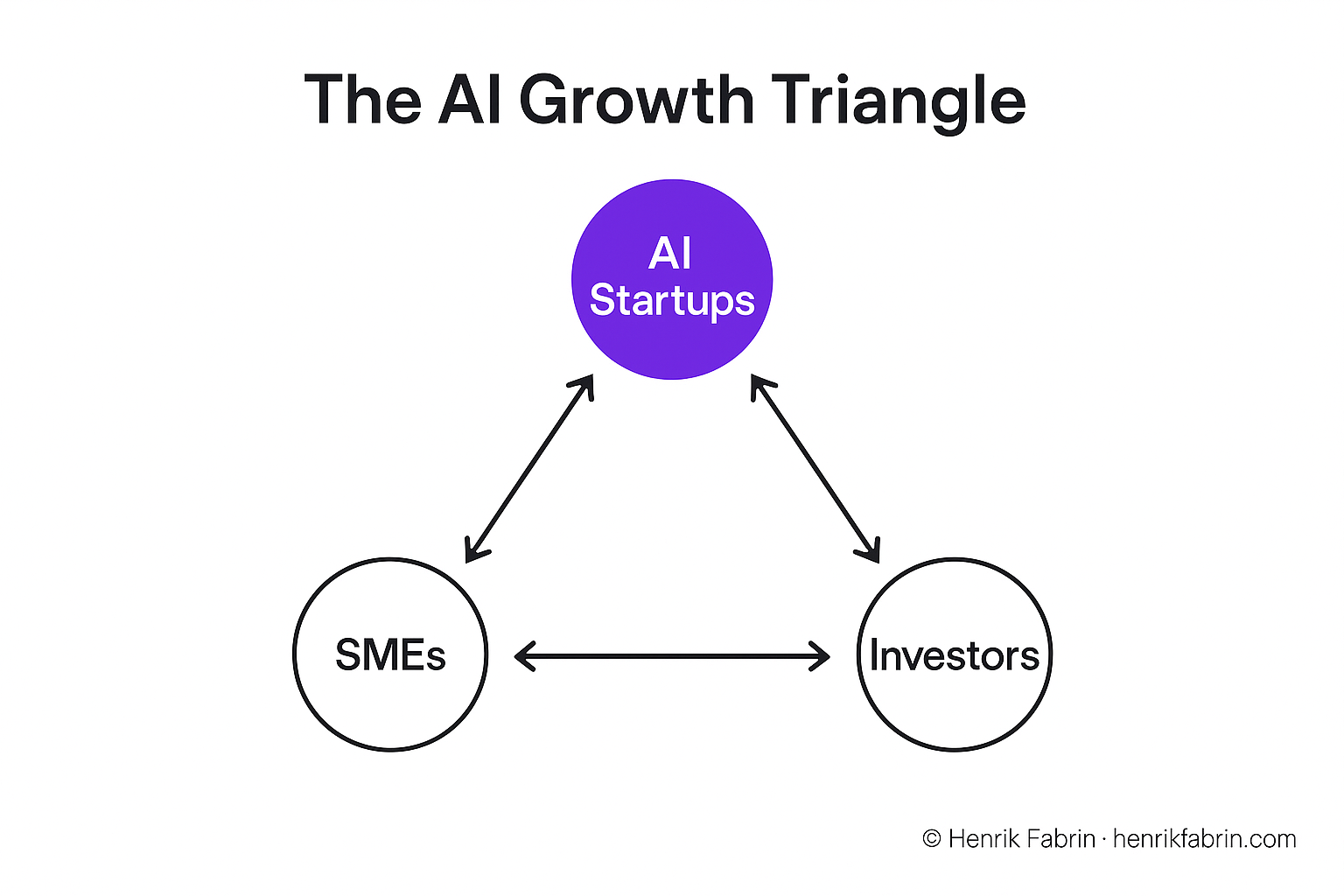
When these three groups connect effectively, they create a flywheel of growth, one that keeps learning, innovation, and revenue circulating within Europe.
At scale, this forms a self-reinforcing growth loop:
SME demand → Startup traction → Investor confidence → Local innovation & revenue → SME adoption.
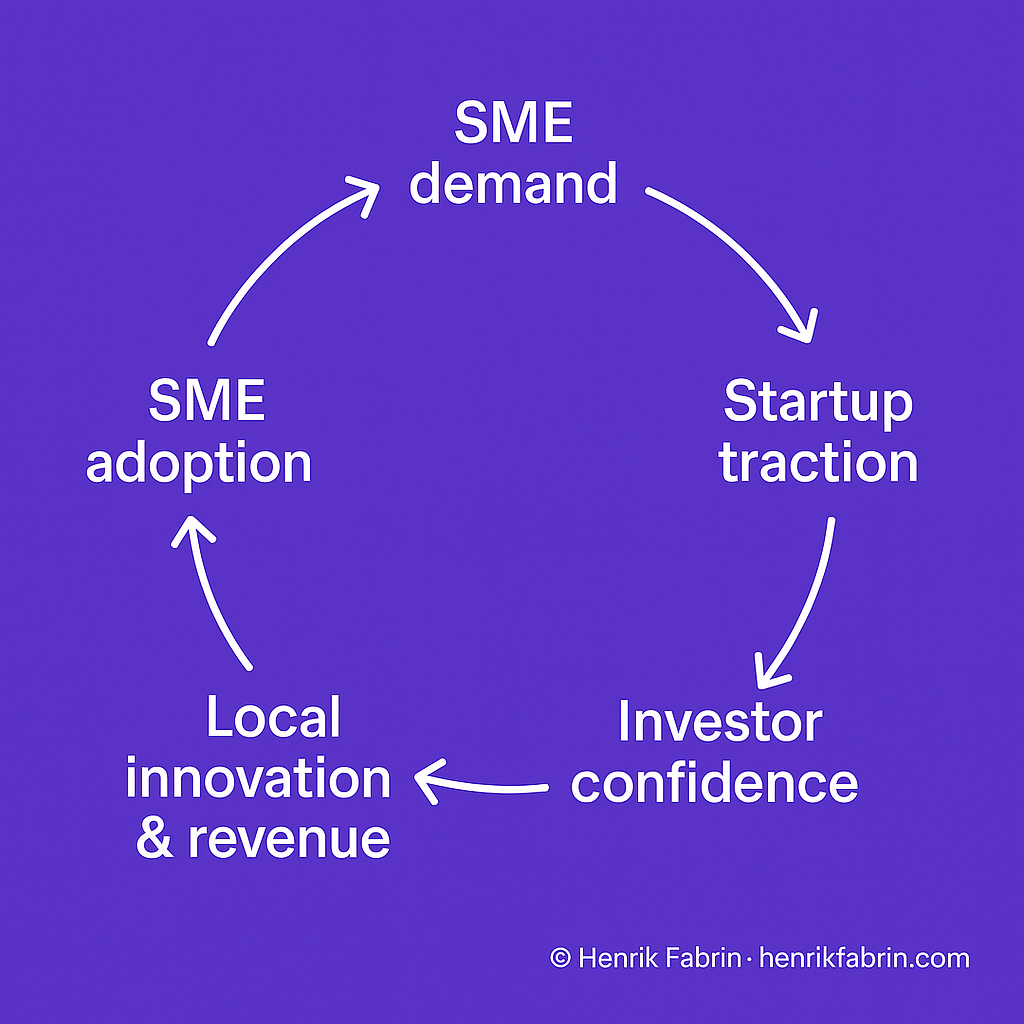
That's the AI growth triangle, and Europe can lead in building it.
From policy support to market builders
This is where national ecosystem builders, business associations, innovation agencies, and digital programs, come in. Their role is to connect and accelerate each side of the AI growth triangle.
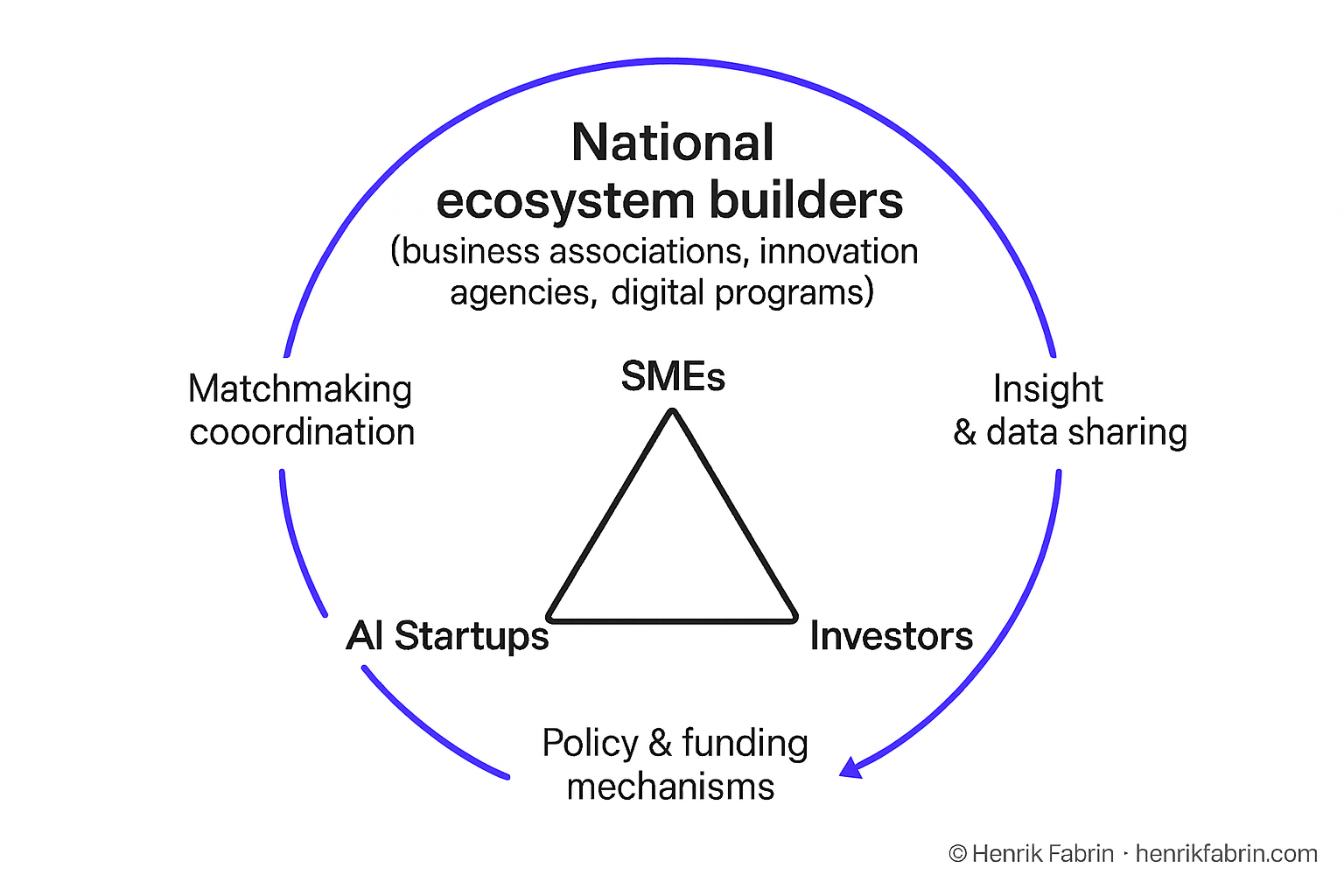
1. From consultancy to coordination
Programs like Denmark's SMV:Digital have proven how tailored support helps individual firms, but 1:1 consultancy doesn't scale. The next step is sector-based adoption tracks — where SMEs get started and scale using AI from European vendors.
That's the primary goal: helping more companies take real steps into AI adoption. The secondary effect is powerful too; these programs surface new problems-to-solve for startups and researchers, feeding the next wave of innovation.
2. Build shared visibility and trust
Through AI for Alle, DI is building a living catalogue of how Danish companies adopt AI: what works, where they struggle, and the tangible business impact.
This approach can scale across Europe:
- It inspires other SMEs through relatable examples.
- It informs European AI startups about real market needs.
- And it shapes public understanding: Danish media already use these stories extensively to show how AI adoption looks in practice.
This kind of shared insight turns isolated experiments into a collective European learning system.
3. Close the revenue loop
Every time a European SME adopts a non-European AI product, value and learning flow outward. By connecting SMEs with European AI vendors, institutions like DI and DBBD can ensure that:
- SME value creation = European job creation
- Public support = local growth multiplier
This isn't about protectionism: it's about economic coordination. Keeping the benefits of adoption, data, insight, and revenue, circulating within Europe's own ecosystem.
When all these elements work together, they form more than a loop; they form a system that strengthens itself with every turn.
Each SME that adopts a European AI solution helps a startup grow. Each growing startup gives investors confidence to fund the next one. And each new investment fuels more local innovation and adoption.
That's the compounding effect, progress that scales through coordination rather than competition.
From momentum to momentum: the compounding effect
If scaled across countries and sectors, this model could do for Europe's AI economy what industrial clusters once did for manufacturing: build density, learning, and momentum that multiply over time.
It's a practical path to make Europe's AI ambition real: not just sovereign AI, but shared prosperity AI.Not just adoption, but accumulation, where every SME success strengthens Europe's own AI ecosystem.
Europe's AI growth triangle isn't theory. It's how we turn momentum into momentum and adoption into acceleration.