When new technology gains momentum, adoption follows a specific pattern. This is also true for AI.
When a new technology emerges, it is not simultaneously adopted by the entire market. Different segments adopt it over time, and so does AI.
Whether you're already well into AI or still figuring out if it can make a difference for you, there are others like you. The adoption of AI follows the same pattern as other technologies. That's because even though AI is in many ways very, very different from what we've been used to, we're still human, and we have the same motivations, curiosity, and caution. However, the degree of our curiosity and willingness to take risks determines how quickly each of us embraces new technology.
In conversations with business leaders and employees, I am often asked when it is the right time to start using AI. The standard answer has been "better now than tomorrow," but the answer is actually more nuanced because it depends on the person or company and the goal.
This article describes when different groups adopt new technology during its market diffusion and why they do so. It can help you understand where, for example, generative AI is on the adoption curve and where your industry, your company, and you are.
Wherever you are on the curve is okay because it is your natural approach to new technology. Of course, you can change your approach, but that is up to you.
The adoption curve
The typical curve looks like the illustration below. Adoption occurs over time and is divided into segments of people or companies with similar appetites for new technology.
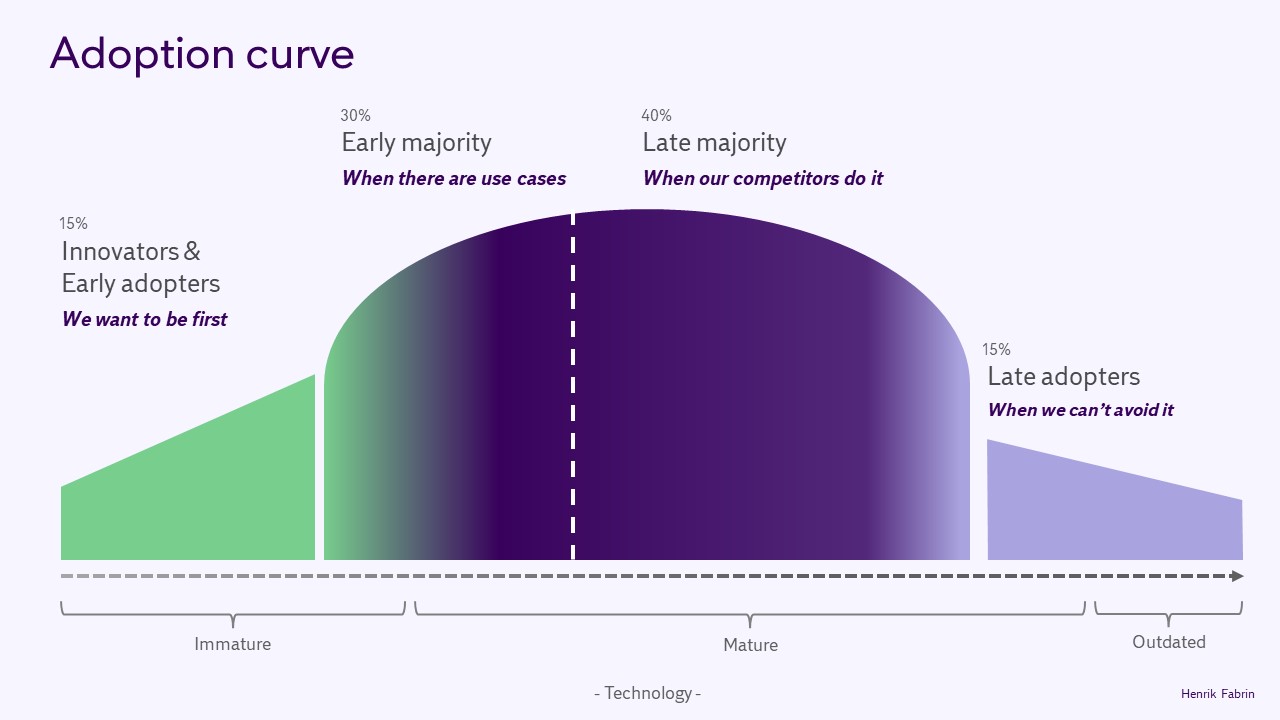
Innovators and early adopters are the first 15% of a market to embrace new technology. They do this before everyone else, partly because they are curious about the technology and partly because they want to be first. If the new technology is helpful to them, it gives them a competitive advantage.
They are highly experimental, have a high risk-tolerance, and are committed to achieving new competitive advantages before anyone else, regardless of how much time and money they spend on it. They accept a high failure rate and waste in the process because they believe the results can outweigh any costs.
Early majority: People or companies in the early majority segment are keen to gain competitive advantages using new technology. However, they prefer to wait until the first positive examples exist in the market. The early majority use the early results of innovators and early adopters to understand the right place to start.
They do this to avoid spending too much time and resources on use cases that do not provide positive ROI. The early majority segment is about 30% of the market.
Late majority: This segment does not focus on being first but on minimizing mistakes and unnecessary costs. They will typically only adopt new technology when other companies or people like them are doing it and when there are many positive examples from their industry. The late majority typically represents 40%.
Late adopters make up the last 15% of new technology adopters. They are the least experimental and risk-averse segment and only adopt technology when they have to. Typically, the rest of the market perceives technology as obsolete, which is less important to late adopters.
For them, stability and maintaining the status quo are more critical, and they only adopt new technology when it is necessary for external reasons, such as standardization, competition, or legislation. That is when the technology is essential for their continued existence in the market.
Where do you fit on the adoption curve? That depends...
Let's leverage generative AI products, such as ChatGPT and Midjourney, to find out where you naturally belong on the curve.


Which of these examples do you recognize yourself in?
Were you among the first in your workplace to try ChatGPT and Midjourney to generate text and images? Was your primary motivation curiosity? Did you do it before the company had a strategy and HR policy? Are you still using generative AI today?
If yes, you are among the first 15% on the generative AI adoption curve. You are one of the people colleagues and others come to for good examples and advice on the do's and don'ts.
Are you one who became curious after the first colleagues started using ChatGPT? Have you waited until you've seen several examples from colleagues or in your (AI-driven) feed on LinkedIn to start using it yourself?
If yes, then you belong to the Early majority segment. You are happy to use new technology, but wait until you can rely on concrete examples.
Are you waiting until you've seen numerous examples of using ChatGPT from other companies in your industry or colleagues and people in your network working in the same field as you? Do you want to save time and effort on something that doesn't work?
Then you belong in the Late majority segment. New technologies like ChatGPT and Midjourney must be mature and proven before adoption.
Do you not change how you work today or your company's processes? Do you take comfort in routines and enjoy predictability? Do you only change habits when something external makes them necessary? Then, you are a late adopter. You are glad you haven't started using AI yet. "If it ain't broken, why fix it?" is the mantra for you and your business.
Your position on the adoption curve can easily be changed
Even if you belong to one place on the curve today, it's far from certain that you always will. There are different reasons for when you adopt new technology changes. Here are a few examples:
Type of technology and its purpose: You can be one of the first to use ChatGPT, but at the same time, be one of the last to use facial recognition to unlock your phone. Both technologies are AI, but you're more comfortable with one type than the other.
Therefore, your position on the curve is relative to, for example, the type of technology and what you want to use it for.
Companies are not static. They are organizations of people who control the company's actions and direction.
A company may be positioned as always being first with new technology, but all it takes is for new people to be given responsibility before the company suddenly falls further behind.
The reverse can also be true; due to employee turnover, the company suddenly goes from not wanting to take risks to wanting to be first with new technology.
The company's people decide the position on the curve, not the company itself.
Conclusion: Understanding comes before acting
When considering when to embrace new technology, such as generative AI, you can use the adoption curve to identify which segment you belong to. If you know where you belong, you can more easily set goals for when to get started.
Do you want to be first, whatever the cost? Do you want to wait for the first positive examples until your competitors are well underway or when you can't avoid them? They are the most important questions because they set the bar for when and how you will implement them.
I'm usually a pragmatic innovator/early adopter, so I advise those asking me to "start today rather than tomorrow."
Understanding comes before acting, and creating your own experiences is essential.
So do as Nike says: Just Do It.